
What is Clinical Psychology? A Guide to Choosing the Right Support
Clinical psychology is a specialised area of mental health care that focuses on understanding, assessing, and treating more complex or persistent mental health disorders. According to the Australian Bureau of Statistics, an estimated 42.9% of Australians aged 16 to 85 have experienced a mental disorder at some point in their life, and 21.5% had one in the past 12 months, with anxiety being the most common.
If you live in Sydney or anywhere else in Australia, these numbers show that seeking support is far more common than many people realise. A clinical psychologist typically works with you through psychological assessment, structured therapy sessions, and evidence-based psychotherapy techniques, such as cognitive behavioral therapy, to help you understand what you are experiencing and develop practical ways to manage it.
You might wonder how t his differs from general psychology or other forms of support. General practitioners in psychology and allied health tend to focus on everyday life challenges, personal growth, and emotional support, while clinical psychology is more suited to diagnosing and treating mental health disorders in greater depth. Both paths sit within the broader mental health services and allied health service system in Australia, and both aim to support your emotional wellbeing. The right psychology service for you depends on what you are going through, how long you have been experiencing it, and what kind of mental health treatment feels right for your goals. Understanding this difference can help you feel more confident about the next step you take.
Understanding the difference between clinical psychology and general support is a great first step, and reaching out is the next one. The team at Alex Rodriguez Allied Health is here to help you find the right support for your needs. Call 0429 220 646, email info@alexrodriguez.com.au, or book a consultation online to get started.




Alexander Rodriguez
Seize the Day, Book an Appointment Today
Reach out anytime. Book online, call us, or visit our office in person.
Key Takeaways
- Clinical psychology treats complex or long-standing mental health disorders using psychological assessment and evidence-based psychotherapy techniques.
- General psychology supports everyday challenges and personal growth through practical emotional support.
- Both are registered with the Psychology Board of Australia, but training and focus differ.
- The right psychological service depends on your needs and goals for mental health treatment.
- Personalised therapy sessions can help support your emotional wellbeing, whichever path you choose.
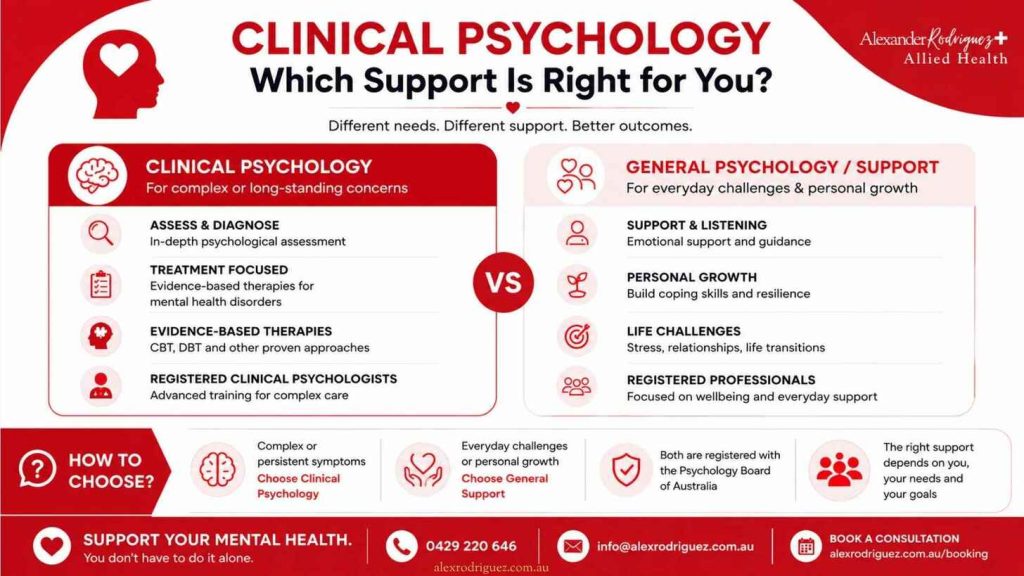
Why Understanding Clinical Psychology Can Help You Choose Support
Finding the right mental health services can feel overwhelming, especially when you are already going through a difficult time. Many people are not sure where to start or which type of support actually matches what they are experiencing. This is where understanding clinical psychology becomes genuinely useful. Clinical psychology focuses on more complex or long-standing mental health disorders, using structured psychological assessment and evidence-based psychotherapy techniques, such as cognitive behavioral therapy, to help you work through what you are facing in a practical, step-by-step way. Other forms of support, such as counselling or life coaching, tend to focus more on emotional support, personal growth, and everyday life challenges rather than diagnosing or treating a specific disorder.
Knowing this difference matters because it directly shapes the kind of help you receive. If you are dealing with persistent anxiety, low mood, or a diagnosed condition, regular therapy sessions with a clinical psychologist may be more appropriate than general guidance alone. On the other hand, if you are navigating stress, relationship difficulties, or personal development goals, a broader psychology service or allied health service may be a better fit. Both approaches sit within Australia’s wider mental health services system, and both are designed to support your emotional wellbeing in different ways. Taking the time to understand these differences can help you feel more confident and less overwhelmed when deciding on the right path for your mental health treatment.
What the comparison means for your mental health care
In Australia, both clinical and general psychologists are well-trained. Knowing the difference helps you find the right help for your needs. This confidence is key when choosing mental health services.
How clinical and general psychology services can overlap
Both fields share common goals. They aim to offer top-notch emotional support and strategies for life’s challenges. Visiting a place like Alex Rodriguez Allied Health or another clinic, you’ll find both paths provide:
- Evidence-based therapy techniques.
- A safe space to explore your thoughts and feelings.
- Practical tools for managing daily stress and emotional well-being.
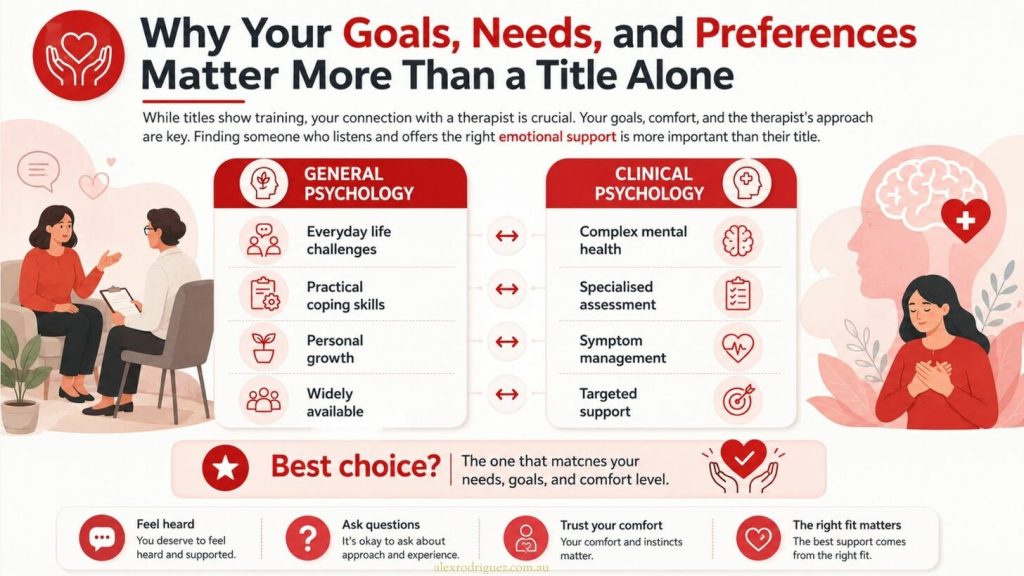
Why your goals, needs, and preferences matter more than a title alone
While titles show training, your connection with a therapist is crucial. Your goals, comfort, and the therapist’s approach are key. Finding someone who listens and offers the right emotional support is more important than their title.
| Service Aspect | General Psychology | Clinical Psychology |
|---|---|---|
| Primary Focus | Everyday life challenges | Complex mental health |
| Therapy Style | Practical coping skills | Specialised assessment |
| Goal Setting | Personal growth | Symptom management |
| Accessibility | Widely available | Targeted support |
What Is Clinical Psychology?
Clinical psychology is a specialised field within psychology that focuses on assessing, understanding, and treating a wide range of mental health disorders, from anxiety and depression to more complex or long-term conditions. It combines scientific research with practical, evidence-based care, so the support you receive is grounded in methods that have been tested and refined over time, not guesswork. In practice, this usually means working with a clinical psychologist through a structured psychological assessment, followed by regular therapy sessions designed around your specific needs. Clinical psychologists are trained in a range of psychotherapy techniques, including cognitive behavioral therapy, which helps you identify unhelpful thought patterns and build more effective ways of coping. This approach is different from general emotional support or life advice, as it is specifically aimed at understanding the root of what you are experiencing and working towards meaningful, lasting change.
Clinical psychology sits within the broader mental health services and allied health service system in Australia. It can be a helpful option if you are dealing with persistent symptoms, a diagnosed condition, or challenges that have not improved with general support alone. The goal is not just to manage difficult moments as they arise, but to build practical strategies and greater self-understanding that support your emotional well-being over the longer term.
How clinical psychology addresses mental health disorders and emotional well-being
Clinical psychology focuses on treating mental health disorders. It looks at both your emotional and functional health. This approach helps you find your way back to recovery.
At Alex Rodriguez Allied Health, we believe in a personalized healing path. Whether you’re dealing with ongoing sadness or complex emotions, we have the tools to help you find yourself again.
The role of psychological assessment in understanding your concerns
A psychological assessment is the first step to understanding your issues. It dives deep into your symptoms, history, and current life. This helps clarify what you’re going through.
This process highlights specific challenges affecting your life. Knowing these areas helps your psychologist tailor your mental health treatment for maximum effectiveness.
How clinical psychologists develop individualised mental health treatment plans
Everyone is different, so your care should be too. Clinical psychologists craft plans that match your personal goals and needs.
Assessment, diagnosis and treatment planning
In your first sessions, your psychologist will gather information with you. This teamwork ensures an accurate diagnosis and a treatment plan that’s solidly based on understanding.
Evidence-based therapy and ongoing progress review
Your therapy will use proven psychotherapy techniques for lasting change. These methods are regularly checked to make sure they still meet your needs.
- Individual Therapy Sessions tailored to your specific pace.
- Regular reviews to track your progress and adjust strategies.
- Application of evidence-based psychotherapy techniques to manage symptoms.
- Ongoing support to help you build resilience and long-term wellbeing.
What Does a General Psychologist Do?
A general psychologist focuses on helping you manage everyday life challenges, stress, and personal growth, rather than diagnosing or treating complex mental health disorders. If you are feeling overwhelmed, stuck in unhelpful patterns, or simply want extra emotional support as you work through a difficult period, a general psychologist can offer practical guidance and a safe space to talk things through. This kind of support often overlaps with the wider allied health service system, and it can be a helpful starting point if you are not sure whether you need more specialised care.
Sessions with a general psychologist may still involve elements of psychotherapy techniques, such as cognitive behavioral therapy, but the focus tends to stay on building coping strategies, improving relationships, and supporting day-to-day well-being rather than working through a diagnosed condition. This makes general psychology a good fit for people navigating stress, low motivation, grief, or life transitions. As part of a broader psychology service, it works alongside other forms of support to help you feel more balanced, clear-headed, and better equipped to handle whatever life brings.
The role of a general psychologist in everyday emotional support
Emotional support is a key part of maintaining a healthy, balanced life, and a general psychologist can play an important role in providing it. They offer a safe, supportive space to explore your feelings, without judgement and at your own pace. Whether you are navigating life changes, work stress, or everyday worries, a general psychologist can help you work through what you are experiencing and build practical ways to cope.
Common concerns addressed through general psychology therapy
General psychology therapy helps you manage your mental health. It’s for any life event or feeling overwhelmed. You’ll learn to change unhelpful patterns into healthier habits.
How general psychologists support coping, relationships, and personal growth
Improving your emotional well-being means bettering your relationships and self-awareness. You’ll learn to communicate better and set boundaries. This helps you grow and move forward with confidence.
Stress, anxiety and low mood
Stress Support and Anxiety Support services offer relief. We help you find what triggers your stress and teach calming techniques. Early action on low mood can stop it from lasting too long.
Self-esteem, emotional regulation and resilience
Having a positive self-image is crucial for your health. Through Self-Esteem Building Support and Emotional Regulation Support, you’ll learn to handle intense feelings. These skills help you face future challenges with strength.
| Support Area | Primary Focus | Expected Outcome |
|---|---|---|
| Stress & Anxiety | Managing daily pressure | Increased calm and focus |
| Self-Esteem | Building self-worth | Greater confidence |
| Emotional Regulation | Managing intense feelings | Improved stability |
| Relationships | Communication skills | Healthier connections |
Clinical Psychology vs. General Psychology: Key Differences
Understanding the difference between clinical psychology and general psychology can help you choose the right kind of support for your situation. In Australia, both clinical and general psychologists are registered with the Psychology Board of Australia, but they follow different training pathways and tend to focus on different areas of care. Clinical psychologists complete additional postgraduate training, usually a master’s or doctorate, with a specific focus on assessing and treating mental health disorders. This extra training allows them to work with more complex or long-term conditions, using structured psychological assessment and specialised psychotherapy techniques. General psychologists, on the other hand, typically hold a four-year psychology qualification followed by supervised practice, and tend to focus on everyday challenges, stress, and personal development rather than diagnosing specific disorders.
In terms of what this means for you, therapy sessions with a clinical psychologist are often more suited to conditions such as anxiety disorders, depression, or trauma, where a structured, evidence-based approach like cognitive behavioral therapy is helpful. General psychology sessions tend to focus more on emotional support, coping strategies, and life challenges. Both pathways fall under the broader mental health services and allied health service system in Australia, and choosing between them often comes down to the nature and severity of what you are experiencing, as well as your personal goals for mental health treatment. If you are unsure which option suits you best, discussing your situation with apsychology service provider can help clarify the right path forward.
Training, areas of expertise, and professional registration in Australia
All psychologists in Australia must meet strict standards. General psychologists study for four years and then two years of supervised practice. Clinical psychologists get more training, often a Master’s or Doctorate, focusing on the mental health treatment of complex conditions.
This extra education makes clinical psychologists experts in evidence-based interventions. Both are skilled, but their training shapes their approach to your care in an allied health service.
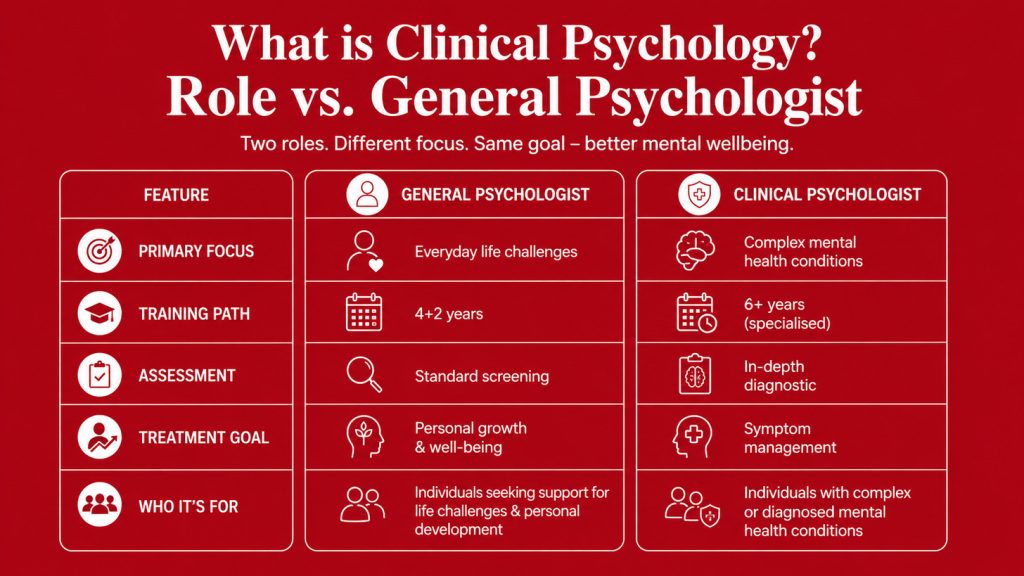
Differences in psychological assessment and complex mental health treatment
The depth of psychological assessment needed can decide which professional you choose. Clinical psychologists are trained to treat complex mental health disorders. They create detailed plans for recovery.
General psychologists are great for everyday stressors, relationship issues, and personal growth. Both are key to quality mental health services.
How therapy goals and treatment intensity may vary
Your therapy goals affect the support intensity. Some need short-term sessions, others long-term for persistent symptoms. Your psychologist will help find the right pace for you.
Clear comparison of clinical and general psychology services
Here’s a comparison of these services in Australia.
| Feature | General Psychology | Clinical Psychology |
|---|---|---|
| Primary Focus | Everyday life challenges | Complex mental health |
| Training Path | 4+2 years | 6+ years (specialised) |
| Assessment | Standard screening | In-depth diagnostic |
| Treatment Goal | Personal growth | Symptom management |
Scope of support
General psychology is good for stress, anxiety, and relationship issues. Clinical psychology is for complex or chronic mental health concerns.
Assessment options
Both use psychological assessment tools. Clinical psychologists might use more specialised tests for complex conditions.
Therapy approaches
Both use evidence-based methods like cognitive-behavioural therapy. They also use compassionate, client-centred techniques.
When referral or additional care may be recommended
Your needs might change over time. If needed, your psychologist will discuss a referral. This ensures you get the best mental health treatment through your allied health service.
Therapy Approaches You May Encounter
Therapy is not a one-size-fits-all process, and finding the right approach for you is an important part of your personal growth. Different psychotherapy techniques are suited to different needs, which is why your therapy sessions are often shaped around what you are experiencing rather than a fixed formula. One of the most widely used approaches is cognitive behavioral therapy, which helps you notice unhelpful thought patterns and develop more balanced, practical ways of responding to them. Other approaches may focus on processing past experiences, improving relationships, or building emotional resilience, depending on what a psychological assessment identifies as most helpful for you.
At Alex Rodriguez Allied Health, we believe that understanding the tools used in your care can help you feel more informed and involved in the process. Knowing why a particular technique is being used and how it connects to your goals can make mental health treatment feel less overwhelming and more collaborative. Whether you are working through a specific mental health disorder or simply looking for emotional support during a difficult period, the right approach is one that fits your circumstances, respects your pace, and supports your emotional well-being as part of a broader psychology service.
How cognitive-behavioural therapy can help change unhelpful patterns
Cognitive-behavioural therapy is a common method. It helps you see how your thoughts, feelings, and actions are connected.
By changing negative thoughts, you can adopt more positive ones. This helps you break free from patterns that hold you back.
Psychotherapy techniques for understanding thoughts, feelings and behaviour
There are many psychotherapy techniques to help you understand yourself better. These methods let you explore how past experiences shape your reactions today.
Through these sessions, you’ll get to know your emotional landscape better. This knowledge is the first step to making lasting changes.
Emotional regulation strategies for managing intense feelings
If you often feel overwhelmed, emotional regulation strategies can help. These strategies help you stay calm when life gets tough.
You’ll learn to identify what triggers your intense feelings and how to respond calmly. This skill helps you handle difficult moments better.
Trauma-informed support and safe, client-centred therapy
We focus on trauma-informed care to ensure your safety and respect. Your care is built on empathy, trust, and working together.
Your opinions are crucial. We make sure your care matches your values and comfort levels.
Building practical coping skills between therapy sessions
What you do in therapy sessions is just part of the journey. We encourage you to use new skills in your daily life to build resilience.
- Journaling to track your mood and triggers.
- Mindfulness exercises to stay present.
- Setting small, achievable goals for the week.
- Using breathing techniques to manage stress.
Adapting treatment to your needs, preferences and progress
Your path to wellbeing is unique, and your treatment plan should reflect that. We regularly review your progress to ensure the support you receive remains relevant and effective.
If your needs change, we adapt our approach to better suit your current circumstances. This flexibility ensures that you always receive the most helpful support for your specific goals.
Which Psychology Support May Suit Your Needs?
Finding the right support can make a real difference to how you feel, and the best option often depends on what you are experiencing and how long it has been going on. If you are managing everyday stress, life transitions, or personal growth goals, a broader psychology service or emotional support focused approach may be enough to help you feel more balanced. If your experience involves persistent symptoms, a diagnosed condition, or something that has not improved with general support, clinical psychology may be a more suitable path, offering structured psychological assessment and evidence-based psychotherapy techniques such as cognitive behavioral therapy through regular therapy sessions.
Understanding your options is often the first step towards feeling better. There is no single right answer for everyone, and it is common to need different levels of care at different points in life. Whether you are looking into mental health services, a wider allied health service, or a more specialised psychology service, the goal is to find support that matches your needs and helps you work towards better emotional wellbeing. If you are unsure where to start, discussing your situation with the team can help clarify the right kind of mental health treatment for you.
When clinical psychology may be appropriate for complex or persistent concerns
If you’re dealing with complex mental health disorders, clinical psychology might be right for you. This field is trained to handle severe or long-term conditions with evidence-based mental health treatment.
Professionals in this area help those with persistent symptoms. They are skilled in diagnosis and creating recovery plans.
When general psychology therapy may provide suitable support
General psychology is great for everyday life changes or specific issues. It offers a supportive space to explore thoughts and feelings. It’s not as intense as clinical psychology.
Many find it helpful for daily living tools. It’s perfect for personal growth or managing common stressors.
Support for stress, anxiety and depression
At Alex Rodriguez Allied Health, we offer Depression Support and anxiety management. We use cognitive-behavioural therapy to change unhelpful thought patterns.
This approach is effective for various mental health disorders. Together, we can help you find balance and calm.
Support for trauma, family stress, and relationship issues
Life events can be tough, but you’re not alone. We offer Trauma Support, Family Stress Support, and Relationship Issues Support. We help you heal and reconnect.
- Safe, non-judgmental environments for processing past experiences.
- Practical strategies to improve communication within your family.
- Guidance on building healthier boundaries in your relationships.
Support for mental clarity, resilience and self-esteem
Sometimes, you just want to feel more confident. Our Mental Clarity and Resilience Support helps you handle life’s ups and downs.
Through Self-Esteem Building Support, you can challenge your inner critic. This mental health treatment empowers you to move forward with strength and purpose.
What to Expect from Psychological Assessment and Therapy Sessions
Starting therapy can feel daunting, but taking that first step is a genuinely courageous move towards better well-being. If you begin with a psychological assessment, this usually involves a conversation about what you are experiencing, your history, and your goals, so your psychologist can understand your situation clearly before recommending a way forward. From there, your therapy sessions are shaped around your specific needs, whether that involves cognitive behavioral therapy or another evidence-based approach, and the pace is set according to what feels manageable for you.
You do not need to have everything figured out before you begin. Many people feel unsure or a little anxious before their first session, and that is completely normal. Over time, therapy is designed to offer practical emotional support, helping you build strategies for managing mental health disorders or everyday challenges, while working towards mental health treatment goals that matter to you. Whether you access this through a general psychology service or a broader allied health service, each session is a step towards finding the right path forward and supporting your long-term emotional well-being.
What happens before your first appointment
Before you go to Alex Rodriguez Allied Health, you’ll fill out some paperwork. This helps your practitioner understand you before you arrive.
- Confirming your appointment time and location.
- Completing intake forms regarding your history.
- Reviewing any referral documents from your GP.
How your psychologist explores your goals and current circumstances
In your first meeting, your psychologist will listen to your story. They want to know what brings you here and what you hope to achieve.
You’ll talk about your challenges in a safe, non-judgmental space. This conversation is the start of your work together.
What a psychological assessment may involve
A psychological assessment helps understand your specific concerns. It’s not a test, but a tool to clarify your needs.
Your practitioner might use questionnaires or interviews to gather information. This ensures your care is tailored to you.
How individual therapy sessions are structured
Therapy sessions usually follow a set pattern to make you feel secure. You’ll start by talking about your week and what’s important to discuss.
Your psychologist will then guide you through strategies to manage your emotions or thoughts. These sessions are collaborative and practical.
Discussing confidentiality, boundaries and treatment expectations
At the start, your psychologist will explain confidentiality. You’ll know how your information is stored and when it might be shared.
Setting clear boundaries keeps your relationship professional and supportive. You’ll also discuss what you can expect from your mental health treatment in the coming weeks.
Reviewing progress and adjusting your support plan
Your needs may change, and that’s okay. You and your psychologist will regularly review your progress to ensure your goals are still relevant.
If something isn’t working, your practitioner will adjust your support plan. This flexibility ensures your care always meets your personal growth.
How to Choose the Right Psychology Service in Australia
Finding the right mental health services in Australia can feel like a big decision, especially when you are already going through a difficult time. It helps to start by thinking about what you actually need, whether that is support for a diagnosed mental health disorder, general emotional support, or guidance through a specific life challenge. From there, it is worth considering whether a psychology service offering clinical psychology is the right fit, or whether a broader allied health service better suits your circumstances. Checking that a provider is registered with the Psychology Board of Australia is also an important part of doing your research.
It is also worth thinking about practical factors, such as location, availability, and the type of psychotherapy techniques used, including approaches like cognitive behavioral therapy. Many people in Sydney and Parramatta look for providers who offer both psychological assessment and ongoing therapy sessions, so they can access consistent, personalised mental health treatment without needing to switch providers along the way. Ultimately, the right choice comes down to feeling comfortable, understood, and supported, so you can work towards better emotional well-being at a pace that feels right for you.
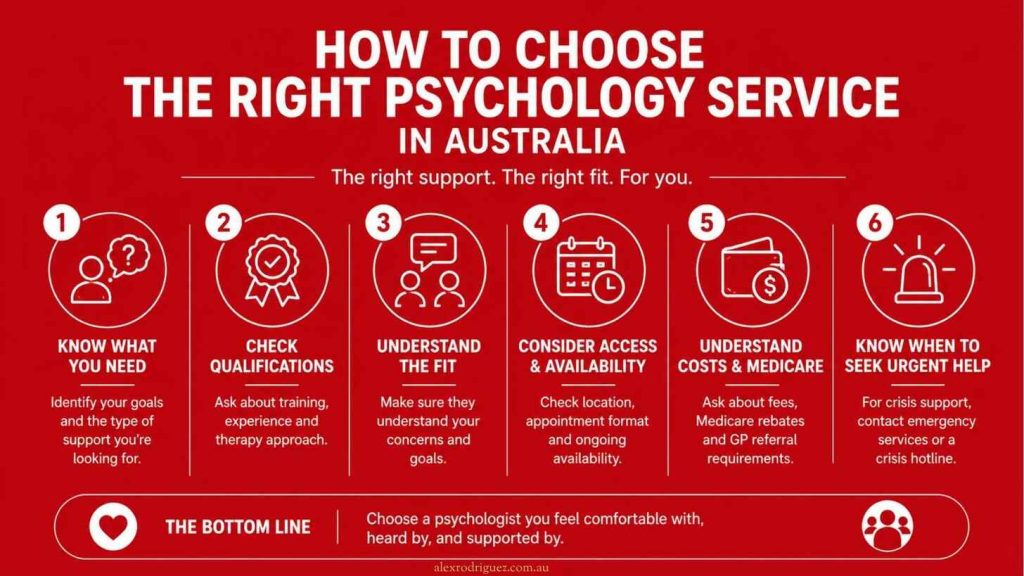
Questions to ask about qualifications, experience, and treatment style
When you call a potential provider, ask about their background. You might want to know about their training, experience, and the therapy models they use. Knowing their treatment style helps you see if it’s right for you.
Checking whether the psychologist understands your specific concerns
Feeling heard and understood is crucial from the start. Ask if they have experience with your issues, like anxiety or relationship problems. A good psychology service will be open about its expertise and if they’re a good match for you.
Considering access, appointment format, and ongoing availability
Practical things matter a lot in therapy. Think about whether you prefer in-person or online sessions. At Alex Rodriguez Allied Health, we make sure you can get the emotional support you need easily.
Understanding referrals, costs and possible Medicare considerations
Before starting, talk about the costs. Ask about session fees, cancellation policies, and whether you need a GP referral for Medicare rebates. While rebates aren’t guaranteed, a Mental Health Treatment Plan from your GP can help with costs.
When your GP or another health professional may be involved
Your GP is key to your health. They might work with your psychologist to cover all your health needs. This teamwork can lead to better results for your emotional support.
When urgent or crisis support is required instead of routine therapy
Routine therapy is for ongoing growth, not for emergencies. If you’re in crisis, call emergency services or a crisis hotline. These services are ready to help in urgent situations.
| Factor | What to Consider | Why It Matters |
|---|---|---|
| Qualifications | Registration and training | Ensures professional standards |
| Accessibility | Location and format | Supports consistent attendance |
| Costs | Fees and rebates | Helps with financial planning |
| Expertise | Relevant experience | Improves treatment effectiveness |
Psychology Services Available from Alex Rodriguez Allied Health
Finding the right support is an important step, and Alex Rodriguez Allied Health offers a range of services designed to meet different needs across mental health and wellbeing. This includes clinical psychology support for more complex or persistent mental health disorders, as well as counselling and general emotional support for everyday life challenges. The team also offers occupational therapy, life coaching, and personal development support, so you can access the type of care that best matches your situation, all within one psychology service.
Every service is approached with a focus on your comfort, pace, and long-term emotional well-being. Whether you need psychological assessment, structured therapy sessions, or ongoing mental health treatment using approaches like cognitive behavioral therapy, the goal is to provide practical, personalised support rather than a one-size-fits-all solution. As part of the broader mental health services and allied health service network, Alex Rodriguez Allied Health aims to make it easier for people across Sydney, Parramatta, and surrounding areas to find the right kind of care for their needs.
General Psychology Therapy for individual mental health support
We provide general therapy to help you overcome life’s challenges. This approach gives you practical tools to improve your daily life and well-being.
Stress Support and Anxiety Support for everyday and ongoing challenges
Life can feel overwhelming, but you’re not alone. Our practitioners offer strategies to manage stress and anxiety, helping you find calm again.
Depression Support and Trauma Support through compassionate therapy
Healing from emotional pain needs a safe space. We offer compassionate care to help you process tough experiences and look forward to a brighter future.
Emotional Regulation Support for managing difficult emotions
Learning to handle intense feelings is crucial for mental health. Our emotional regulation techniques help you stay balanced and composed, even in tough times.
Mental Clarity and Resilience Support for stronger coping skills
Building resilience helps you face challenges with confidence. We help you sharpen your mental clarity and build inner strength to tackle future challenges.
Self-Esteem Building Support for confidence and self-worth
Your self-worth affects every part of your life. Through dedicated support, we help you overcome negative self-talk and build a more positive self-image.
Relationship Issues Support and Family Stress Support
Dealing with relationships and family stress can be tough. We offer a space to explore these issues, helping you build healthier connections with loved ones.
Individual Therapy Sessions tailored to your goals
Everyone is unique, which is why our therapy sessions are tailored to your goals. We make sure your treatment plan is flexible, relevant, and focused on what matters to you.
How to Contact Alex Rodriguez Allied Health
If any of this has resonated with you, reaching out is easier than it might feel right now. Alex Rodriguez Allied Health offers a supportive space where you can share what you are going through, without judgment and at your own pace.
What You Can Expect
Reaching out to a psychology service does not mean you need to have everything figured out first. The team is there to listen, understand your situation, and help you find the right kind of support, whether that is clinical psychology, counselling, or another form of care within our broader allied health service.
Ways to Get in Touch
You can contact the team in whichever way feels easiest for you:
- Phone: 0429 220 646
- Online booking: Book an appointment
When you get in touch, it can help to mention a few things, such as what you would like support with, whether you would prefer an in-person or telehealth session, and your general availability during the week. There is no need to explain everything in detail. A short message is a good place to start.
Conclusion
Understanding clinical psychology and how it differs from general psychology can make a real difference when you are deciding on the right kind of support. Clinical psychology tends to be better suited to complex or long-standing mental health disorders, using structured psychological assessment and specialised psychotherapy techniques such as cognitive behavioral therapy. General psychology, on the other hand, is often more helpful for everyday life challenges, stress, and personal growth, offering practical emotional support along the way. Both pathways form part of Australia’s broader mental health services system, and both are designed to help you move towards better emotional wellbeing.
Throughout this guide, we have looked at what to expect from therapy sessions, how different approaches work, and what to consider when choosing between a general psychology service or a more specialised path. Ultimately, your journey depends on your goals, your circumstances, and the level of care that feels right for you. There is no single correct choice, only the one that best supports your needs at this point in time.
Understanding the difference between clinical psychology and general support is a great first step, and reaching out is the next one. The team at Alex Rodriguez Allied Health is here to help you find the right psychology service and wider allied health service for your needs, whether that is structured mental health treatment or simply a supportive space to talk things through. Call 0429 220 646, email info@alexrodriguez.com.au, or book a consultation online to take the next step towards greater clarity and emotional wellbeing.