What Does ADHD Feel Like as an Adult? Signs You Might Be Missing
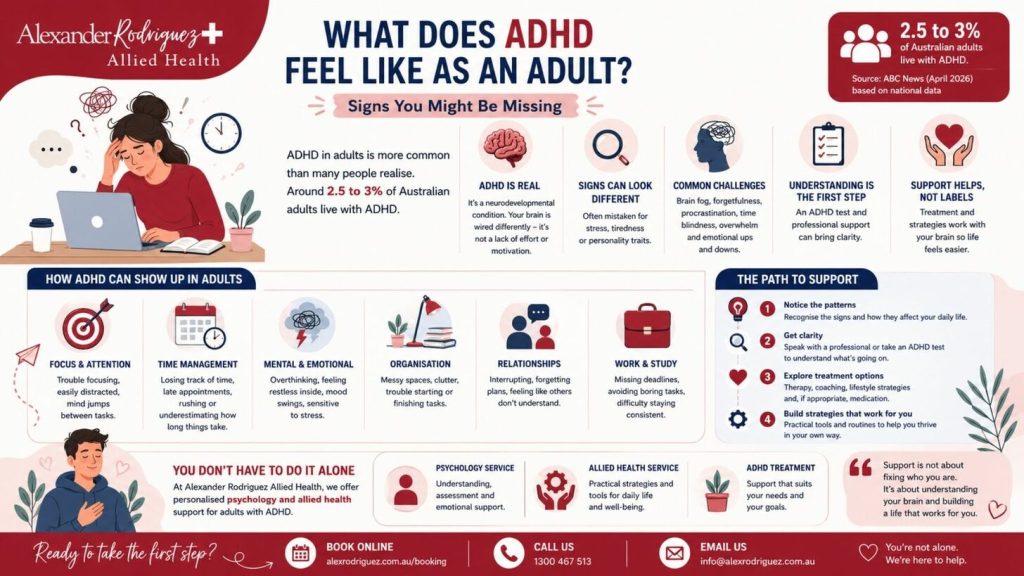
ADHD in adults is more common than many people realise, and it often goes unnoticed for years. Experts estimate that around 2.5 to 3 per cent of Australian adults live with ADHD, according to reporting by ABC News on national prescribing and diagnosis data.
Yet many people still ask what ADHD is only after struggling for years with focus, memory, or motivation. If you have ever felt like your brain is racing while you are just trying to make a simple cup of tea, you are not alone. Many adults feel overwhelmed by constant mental clutter, but they do not always connect this to ADHD symptoms in adults. ADHD is a neurodevelopmental condition. It means your brain is wired differently, not that you lack intelligence, motivation, or good character. It is okay to be different.
Because signs of ADHD can look different in adults than in children, they are often mistaken for stress, tiredness, or personality traits. This is why many people only consider taking an ADHD test later in life, sometimes after years of feeling like something is not quite adding up. Recognising these patterns is the first step. From there, a psychology service or allied health service can help you understand what is really going on and explore ADHD treatment options that suit your life. Support is not about fixing who you are. It is about giving you practical tools that work with the way your brain operates.
You do not have to figure this out alone. Alex Rodriguez offers personalised psychology and allied health support to help you understand ADHD in adults and explore what may help. Book an appointment online, call 1300 467 513, or email info@alexrodriguez.com.au to get started.




Alexander Rodriguez
Seize the Day, Book an Appointment Today
Reach out anytime. Book online, call us, or visit our office in person.
Key Takeaways
- Recognise that your experiences are linked to neurobiology, not personal failure.
- Understand that common struggles like forgetfulness are often misunderstood symptoms.
- Seek professional guidance to navigate daily hurdles with confidence.
- Connect with local experts who provide tailored support for your needs.
- Take the first step by booking a consultation for a clearer perspective.
How ADHD Can Show Up Beyond Childhood
ADHD symptoms often change as you grow older. Many people still think of ADHD as something that only affects children, but ADHD in adults can look very different. Instead of obvious hyperactivity, it often becomes more subtle and internal. You might feel restless on the inside while appearing calm on the outside, or you might struggle quietly with things others seem to manage with ease. If you are still asking what is ADHD at this stage of life, it may help to know that it is a lifelong neurodevelopmental condition, not something you simply grow out of. For many adults, it shows up as difficulty starting tasks, losing track of time, forgetting appointments, or feeling mentally scattered even when you are trying your hardest to stay on top of things. These patterns are often mistaken for laziness or disorganisation when they are actually genuine signs of ADHD.
ADHD symptoms in adults can also affect relationships, work, and everyday routines in ways that are easy to overlook. You might procrastinate on important tasks, feel overwhelmed by simple decisions, or struggle to regulate your emotions during stressful moments. Because these experiences build up gradually, many adults do not consider taking an ADHD test until years of frustration have already passed. Understanding these changes matters because early recognition can make a real difference. A psychologist can help you explore whether what you are experiencing lines up with ADHD. Exploring ADHD treatment options becomes less about labelling yourself and more about finding what genuinely helps you feel steadier and more in control.
What is ADHD in adults?
What is ADHD? It’s a brain condition that affects how you focus, control impulses, and manage emotions. It’s usually divided into three types:
- Inattentive: You might find it hard to focus, stay organised, and complete tasks.
- Hyperactive-Impulsive: You could feel always on the move or act without thinking.
- Combined: You might have traits from both inattentive and hyperactive-impulsive types.
Why adult signs can be overlooked or misinterpreted
As a Child, you had school and parents to guide you. But as an adult, you’re on your own. This change can make it harder to manage your challenges.
Many adults go undiagnosed because their symptoms seem like personality traits or stress.
| Presentation Type | Common Adult Experience | Impact on Daily Life |
|---|---|---|
| Inattentive | Mental fog and distraction | Missed deadlines and forgotten tasks |
| Hyperactive | Internal restlessness | Difficulty relaxing or sitting still |
| Combined | Fluctuating focus and energy | High variability in performance |
How masking and coping strategies can hide everyday difficulties
You might have learned to hide your struggles. Some people use perfectionism, over-preparation, or last-minute efforts to get things done. These strategies can be mentally draining.
Humour or being very smart can also hide adhd in adults. You might seem fine, even when you’re feeling overwhelmed. Recognising these patterns is key to understanding what is adhd and finding support.
Signs of ADHD in Adults You May Recognise
If you often feel like you are running a race with invisible hurdles, you are not alone. Many people find that ADHD in adults shows up as a pattern of behaviour that affects daily life, rather than a single moment or mistake. It is key to tell apart occasional forgetfulness from the ongoing challenges that define these experiences. Recognising signs of ADHD in adulthood can be tricky because they often blend into daily stress or a busy schedule. You might lose track of time and run late even when you plan ahead, start tasks with enthusiasm but struggle to finish them, or feel easily distracted even during conversations that matter to you.
Unlike occasional forgetfulness, which everyone experiences from time to time, ADHD symptoms in adults tend to be persistent and usually show up across several areas of life at once, not just one. This might look like misplacing everyday items such as keys or your phone, finding it hard to switch off even when you want to relax, feeling emotionally reactive in situations that seem manageable to others, or procrastinating on tasks that feel repetitive even when they are urgent. If several of these signs sound familiar and have been part of your life for a long time, it may be worth exploring further with a professional. Recognising these patterns is not about labelling yourself. It is about understanding yourself a little better and giving you room to find support that actually fits how your mind works.
Struggling with ADHD is hard, even when the tasks matter to you
You might stare at a task you really want to do but can’t start. This is called executive dysfunction. It’s not a lack of willpower, but a brain issue with starting actions.
Hyperfocus on interesting tasks but difficulty finishing routine ones
When a task interests you, you might lose track of time for hours. But routine tasks feel hard to keep up with. This contrast is a common sign of ADHD people talk about.
Frequently losing items, details or track of conversations
Misplacing keys, phones, or important documents can be frustrating. You might also find your mind wandering during important talks, making it hard to remember key points.
Feeling overwhelmed by simple decisions and competing demands
Too many choices can overwhelm your brain. This decision fatigue makes even small tasks seem huge. It’s a sign of, ADHD symptoms in adults that can cause a lot of stress.
Needing urgent deadlines to create enough focus to act
Many people need a looming deadline to get moving. Without it, starting tasks is hard.
Switching between tasks without completing what you started
You might start a project, get distracted, and move on before finishing. This cycle of unfinished tasks can leave you feeling tired by the end of the day.
Missing appointments, messages, or important reminders
Despite your best efforts, time might slip away, or you might forget to respond to messages. This is not about not caring; it’s how your brain handles time and priorities.
Feeling that your effort is much greater than the results suggest
You likely work harder than most to keep up, yet the outcomes often feel unfair. This can lead to burnout that’s hard to explain to others.
| Feature | Typical Forgetfulness | ADHD-Related Impairment |
|---|---|---|
| Task Initiation | Occasional delay | Chronic paralysis |
| Focus | Easily redirected | Hyperfocus or total drift |
| Impact | Minor inconvenience | Significant life disruption |
| Consistency | Rarely happens | Persistent pattern |
When Attention Difficulties Feel Like Mental Noise
Does your mind feel like a crowded room where everyone talks at once? For many, this persistent mental static is a sign of ADHD in adults. It is not just being busy. It is the constant fight for focus that makes quiet moments hard to find, even when you are physically still or trying to rest. This kind of mental noise can make it hard to follow a conversation, finish reading a page, or settle into sleep at night, because your thoughts keep pulling in different directions at once.
These ADHD symptoms in adults are often invisible to the people around you, which can make them even harder to explain. You might look calm on the outside while your mind feels overloaded on the inside, jumping between unfinished thoughts, forgotten tasks, and passing worries. Over time, this constant inner static can leave you feeling mentally tired, even after a day that looked ordinary to everyone else. If this sounds familiar, it does not mean something is wrong with you. It simply means your mind processes focus and attention differently, and understanding that is often the first step towards finding what genuinely helps.
Thoughts that move quickly or compete for your attention
Your brain might jump from one topic to another fast. This fast thinking makes it hard to focus on one thing. It feels like trying to listen to five radio stations at once.
Being distracted by sounds, movement, notifications, or internal thoughts
External sounds can easily distract you. A simple notification or background noise can stop your productivity. These ADHD symptoms in adults make it hard to ignore background noise, pulling you in many directions.
Reading the same paragraph repeatedly without absorbing it
Ever finish a page without remembering what you read? This happens when your focus drifts. Your eyes move over the words, but your mind is elsewhere.
Forgetting what you intended to say during conversations
It’s frustrating when a thought disappears when you try to speak. This “mental blank” happens when your brain is overwhelmed. If this often happens, talking to Alex Rodriguez Allied Health might help. Call 0429 220 646 or email info@alexrodriguez.com.au.
How sensory overload can affect concentration and recovery time
Sensory overload happens when too much input overloads your brain. This can lead to fatigue and needing more time to recover. Poor sleep, affecting up to 70% of adults with ADHD, makes this worse.
If daily challenges are tough, remember help is out there. You can explore options or book an appointment online at https://www.alexrodriguez.com.au/booking/ to talk about your experiences in a supportive setting.
Emotional Experiences That Can Accompany ADHD
ADHD is more than just trouble focusing. For many adults, it also brings heavy emotions that can be difficult to explain to others, even the people closest to you. ADHD in adults often includes intense reactions to small setbacks, a deep sense of frustration with yourself when things do not go to plan, or a wave of overwhelm that feels bigger than the situation seems to warrant. You might notice that criticism, even gentle feedback, can sting more than you expect, or that rejection and disappointment linger longer than they do for others around you. These feelings are not a character flaw. They are a common part of how ADHD affects emotional regulation.
Because these experiences are often hidden, many adults carry them quietly, worried that others will not understand or will judge them as being overly sensitive. Over time, this can lead to feelings of shame, low self-worth, or exhaustion from constantly trying to manage emotions on your own. If these feelings ever become intense, persistent, or hard to manage safely, it is important to reach out for support.
Frustration when your performance does not match your ability
Ever had a clear plan for a project but couldn’t do it? This gap between what you can think and what you can do leads to frustration. It’s not a lack of willpower, but a brain challenge.
Strong reactions to criticism, rejection or perceived disappointment
Many adults with ADHD symptoms in adults feel hurt deeply by small criticisms. Even constructive feedback can feel like a big hit. This can make you feel hurt or defensive quickly.
Rapid shifts in motivation, irritation, or emotional intensity
Your emotions can change fast, like a rollercoaster. You might feel ready to go, then suddenly feel angry or tired. These changes are linked to how your brain handles stimulation and dopamine.
Feeling shame after repeated lateness, forgetfulness, or unfinished work
Missing deadlines or forgetting things can make you feel guilty. Over time, this guilt can turn into self-blame. Here are some common feelings:
- Always feeling guilty for not meeting expectations.
- Wanting to hide your struggles to avoid being judged.
- Feeling tired from trying to hide your problems.
Separating emotional regulation challenges from personal character
Remember, these struggles are neurological, not a sign of your worth. If these feelings are hurting you, seeking help is key. You can call Alex Rodriguez Allied Health at 1300 467 513, or email info@alexrodriguez.com.au. For more, check out our online booking to talk to someone who gets ADHD.
Time, Organisation, and Daily Life Challenges
Living with ADHD can make managing your day a big challenge. Many ADHD symptoms in adults include trouble with time and keeping things organised. Even with good plans, your day might still feel messy and hard to control. You might set out with a clear list in mind, only to find hours have slipped by on something unplanned, or realise you have lost track of a deadline you were sure you would remember. This is not about a lack of effort. It often comes down to how the ADHD brain processes time, priorities, and structure differently.
Everyday tasks like paying bills, replying to messages, tidying up, or planning meals can pile up quickly, even when none of them are difficult on their own. You might rely heavily on last-minute pressure to get things done, or feel like you are constantly playing catch-up no matter how organised you try to be. Over time, this can affect your work, relationships, and confidence in your own ability to cope. Small, practical strategies, along with the right support, can make a real difference in bringing a sense of structure back to your day, without expecting yourself to operate the way everyone else does.
Underestimating how long tasks and travel will take
It’s easy to think a task will take just ten minutes when it really takes an hour. This mistake often leads to rushing, stress, and being late. Your sense of time might not match the real time needed for your commute or work.
Experiencing time as either immediate or distant
For many, time seems to exist only in two states: “now” or “not now.” This makes planning for the future hard because deadlines feel far away until they’re urgent. This time blindness makes starting tasks that aren’t urgent hard.
Building complicated systems that are difficult to maintain
You might spend hours making detailed filing systems or complex digital calendars. But these systems can be hard to keep up once they’re no longer new. Focus on simplicity and visibility instead of complexity.
Putting off bills, housework, paperwork, or other low-interest responsibilities
Tasks that don’t excite you can be hard to start. This often leads to a build-up of tasks like paying bills or cleaning. You’re not lazy; your brain just needs more interest to start.
Using alarms, lists, and reminders without consistently following them
Phone alarms or sticky notes can fail because they become background noise. To make them work, try these tips:
- Put visual prompts in places you can’t ignore.
- Break big tasks into tiny, manageable steps.
- Use alarms that require you to move to turn them off.
- Make daily routines that help anchor your day.
If you keep struggling, getting help from a professional can be key. At Alex Rodriguez Allied Health, we help adults build lasting habits. Call us at 1300 467 513. For more help with ADHD in adults, visit our online booking page to book a consultation.
How ADHD Symptoms in Adults Can Affect Work or Study
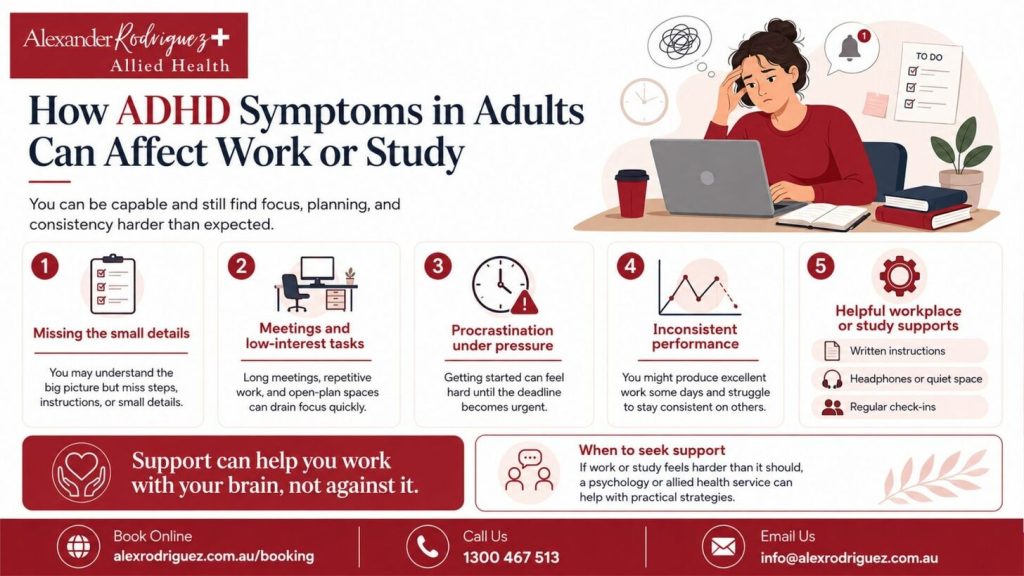
Working or studying can be tough when your brain works differently. You might have the skills, drive, and knowledge to succeed, but the typical office or classroom setup can clash with how you think and focus. It is key to spot ADHD symptoms to understand why some tasks feel harder than they should be, even ones you know you are capable of. You might find it difficult to sit through long meetings or lectures, struggle to follow multi-step instructions, or feel your concentration slipping during repetitive or low-interest tasks, even when the stakes are high. These patterns are often among the clearest signs of ADHD in a work or study setting, even if they were never obvious at school.
ADHD in adults can also show up as trouble managing deadlines, prioritising competing tasks, or staying consistent day-to-day, even when you care deeply about doing well. You might work in bursts of intense focus followed by periods where getting started feels almost impossible, or find yourself easily thrown off by interruptions and unexpected changes to your routine. If this sounds familiar and has been an ongoing pattern rather than a one-off, taking an ADHD test with a qualified professional can help bring clarity. A psychology service or allied health service can support you in exploring practical ADHD treatment options suited to your work or study demands, so you can build strategies that work with your brain, rather than against it.
Missing details despite understanding the bigger picture
You might get the big picture but struggle with the small details. It’s frustrating to see the goal but miss the steps to get there. This gap is common for many.
Finding meetings, repetitive tasks, and open-plan spaces especially difficult
Today’s workspaces can make it hard to focus. Open-plan offices and constant noise pull your attention. Long meetings and repetitive tasks also drain your mental energy.
Procrastinating on projects until pressure becomes overwhelming
Many with adhd wait until the last minute to start. This leads to high stress and an emotional toll. It’s hard to keep up with this pace over time.
Producing excellent work inconsistently rather than predictably
Your work quality can vary a lot. You might do great one moment and struggle the next. This isn’t because you’re not smart or dedicated. It’s how your brain handles focus and motivation.
Workplace adjustments that may support focus, planning, and task completion
Making small changes can help a lot. Ask for written instructions, use headphones, or set up regular check-ins. If these changes are hard, getting professional help can help clarify things.
ADHD and Patterns in Relationships
Relationships can show the special challenges of ADHD in adults. You might find your way of interacting causes problems with partners, friends, or workmates, even when you mean well and genuinely care about the people around you. Common signs of ADHD in relationships can include forgetting important dates, missing details from earlier conversations, or unintentionally interrupting when your mind jumps ahead. You might also struggle with follow-through on shared plans or promises, not because you do not care, but because keeping track of ongoing commitments can be genuinely difficult.
ADHD symptoms in adults can also affect how you handle conflict or emotional conversations, sometimes leading to reactions that feel bigger than the moment calls for or making it hard to stay present during a disagreement. Over time, these patterns can leave you or your loved ones feeling frustrated, even when everyone is trying their best. Understanding this is not about placing blame. It is about recognising that these patterns often connect back to what ADHD is and how it shapes attention, memory, and emotional regulation. With the right support, such as guidance from a psychology service, it is possible to build stronger communication habits and healthier ways of relating to the people who matter most to you.
Interrupting, talking quickly, or struggling to wait your turn
It’s common to feel like you must share your thoughts quickly. This can lead to interrupting or talking fast in conversations. This is a sign of adhd symptoms in adults, but others might think you’re not interested in what they say.
Forgetting plans, messages, or details that matter to other people
You might really care about your loved ones but struggle to remember specific requests or dates. Forgetting a message or missing a planned event is not because you don’t care. It’s because of executive function challenges that it’s hard to keep track of details.
Becoming intensely engaged at first and less consistent later
Many people start relationships or projects with lots of energy and focus. But keeping that level of effort can be hard as things get routine. This change can be confusing for those around you who don’t get why your focus changes.
How communication difficulties can be mistaken for a lack of care
When your actions don’t match your words, others might think you don’t care. They might feel you’re not making them a priority, even when you are trying hard. Open communication is key to explaining that your struggles are due to ADHD, not a lack of interest.
Practical ways to create clearer expectations and reminders
Building systems outside of yourself can help you stay connected and reliable. Here are some strategies to support your relationships:
- Use shared digital calendars to keep track of important dates and commitments.
- Create written agreements for household tasks to remove ambiguity.
- Set up recurring reminder prompts on your phone for messages or check-ins.
- Engage in non-judgmental repair conversations when misunderstandings occur.
If these patterns are affecting your well-being, seeking professional help can help. You can contact Alex Rodriguez Allied Health at 0429 220 646 or email info@alexrodriguez.com.au for support. Or, book a consultation online.
Physical and Behavioural Clues You Might Miss
Ever feel like your body is always on the go, even when you are trying to relax? Many people struggle with staying focused, and ADHD often shows up in physical ways that are easy to miss. These signs are not just about being busy. They are linked to how your body handles stimulation, movement, and restlessness beneath the surface. You might notice fidgeting, tapping, or an inner restlessness that does not settle even when you are sitting still, or find it hard to stay seated for long periods without needing to move, stretch, or change position.
These physical signs of ADHD can also include restless sleep, a tendency to talk quickly or interrupt without meaning to, or a constant need for background noise or activity just to feel comfortable. Some adults notice they seek out high stimulation, like fast-paced tasks or last-minute deadlines, simply to feel switched on and engaged. Others feel the opposite, becoming easily overstimulated by noise, crowds, or too much happening at once. Because these clues are often written off as personality traits or nervous energy, they can go unnoticed for years. Recognising them as genuine ADHD symptoms in adults, rather than just habits, can be an important step towards understanding yourself and finding support that actually fits.
Restlessness, fidgeting, or needing constant movement
In adulthood, hyperactivity isn’t always about running around. Instead, it might look like subtle, persistent movement. This could be tapping your feet, clicking a pen, or shifting in your seat. You might feel the need to keep your hands busy to stay focused during conversations.
Difficulty relaxing because your mind remains active
Even when you’re still, your brain might feel like it’s racing. This constant mental activity makes it hard to wind down at night. Your thoughts might race, making it tough to find true calm.
Impulsive spending, driving, speaking, or decision-making
Impulsivity is a common sign of ADHD that can affect your finances and social life. It might show up as making quick decisions, interrupting others, or taking risks while driving. These actions often happen without thinking about the long-term effects.
Irregular sleep routines and difficulty winding down
Many adults struggle with sleep because their brains won’t shut off. You might stay up late to find some quiet time to think. This cycle can lead to exhaustion, making daily tasks harder to manage.
Seeking novelty, stimulation, or background noise to stay engaged
To stay focused, you might seek out new stimulation. This could mean needing music or podcasts while doing chores. While these strategies help, they also show how your brain tries to stay engaged.
If these experiences sound familiar, you’re not alone. For help, contact Alex Rodriguez Allied Health at 0429 220 646 or email info@alexrodriguez.com.au. You can also book an appointment online to talk to a professional about your concerns.
Conditions and Experiences That Can Look Similar
Understanding what ADHD is means looking beyond the surface. It is easy to assume that every focus or organisation issue points to ADHD, but the picture is often more complicated. Many other factors can affect how you function day to day, including stress, anxiety, low mood, poor sleep, or simply going through a demanding period in life. These experiences can produce similar signs of ADHD, such as trouble concentrating, forgetfulness, or feeling mentally scattered, without ADHD being the underlying cause.
This is why ADHD symptoms in adults should not be self-diagnosed based on a checklist alone. Conditions like anxiety and depression can affect concentration and motivation in ways that closely resemble ADHD, while chronic stress or burnout can also mimic similar patterns of overwhelm and disorganisation. Sleep difficulties, in particular, can significantly impact focus and memory, sometimes without any connection to ADHD at all. Because these experiences can overlap, working through an ADHD test with a qualified professional is important. A proper assessment considers your full history and current circumstances, rather than relying on symptoms in isolation, helping ensure that any support you receive is genuinely suited to what is going on for you.
How anxiety can affect attention, memory, and avoidance
Anxiety keeps your brain always on alert. This can make it hard to focus, leading to memory problems or avoidance of tasks. It’s common to think this worry is just a lack of focus.
Why depression, burnout and chronic stress may resemble ADHD
Burnout and chronic stress can make you feel drained. Depression also affects motivation and focus, similar to ADHD. These states can leave you feeling too tired to do your best.
The impact of sleep problems, trauma, substance use and physical health
Your physical health greatly affects your brain. Poor sleep, health issues, or trauma can hurt your focus. These factors are important to consider when trying to understand your challenges.
Why recognising signs of ADHD is not the same as diagnosing yourself
An online ADHD test can be a starting point. But it’s not a full replacement for a doctor’s evaluation. A professional looks at your history, symptom duration, and how they affect your life.
What information can help distinguish overlapping experiences
Keep a record of your experiences in different places. This helps professionals tell ADHD apart from other issues. If you’re unsure, Alex Rodriguez Allied Health offers a detailed approach.
Call the team at 1300 467 513, or email info@alexrodriguez.com.au to talk about your concerns. You can also book a consultation online.
What an ADHD Assessment for Adults May Involve
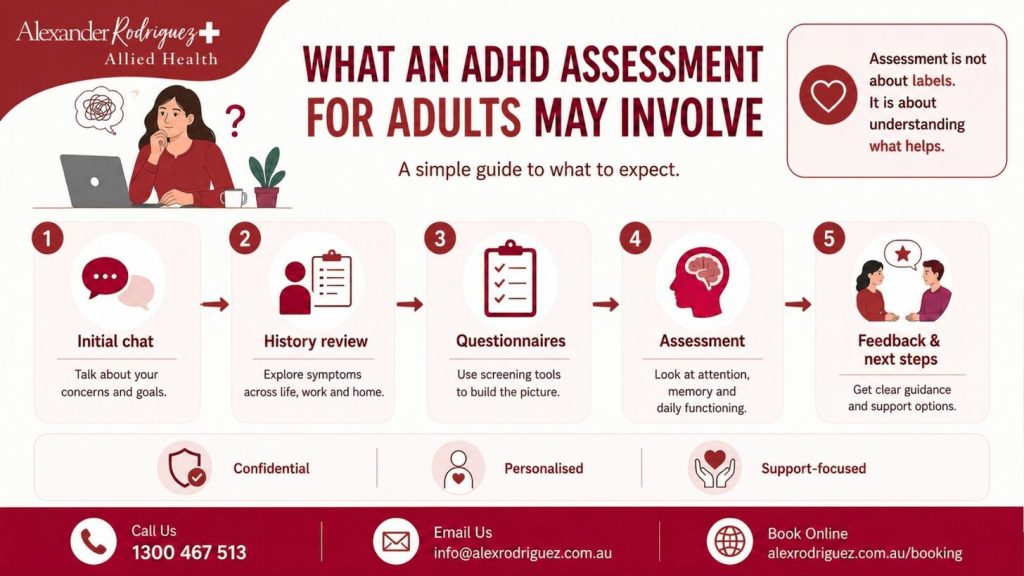
Looking into your mental health is a big step, and knowing what to expect from an ADHD test can make the process feel less daunting. It is not just about ticking boxes on a form. A proper assessment is usually a collaborative process, designed to understand how your brain works and how it interacts with the world around you. This often starts with a conversation about your current experiences, followed by questions about your childhood, since ADHD is considered a lifelong pattern rather than something that appears suddenly in adulthood. You may also be asked about your work, relationships, sleep, and general well-being, since ADHD symptoms in adults can affect many areas of daily life at once.
An assessment may also involve structured questionnaires, standardised checklists, or input from people who know you well, depending on the approach your provider uses. This helps build a fuller picture beyond a single conversation and can help rule out other factors, such as anxiety or stress, that sometimes present with similar signs of ADHD. Every provider’s process can look a little different, so it is worth asking what is involved before you begin. A psychology service can guide you through this process with care, and if ADHD is identified, an allied health service can then support you in exploring practical ADHD treatment and strategies suited to your individual needs.
Starting with your concerns, goals, and day-to-day difficulties
Your journey starts with talking about why you’re seeking help. You’ll share your struggles, like focusing or managing time. Talking about your goals helps the clinician tailor the assessment to you.
Exploring symptoms across childhood, adulthood, and different settings
ADHD often starts in childhood. A clinician will look at if your symptoms were there then and how they’ve changed. They’ll see how these traits show up in different places, like home, social life, and work.
Reviewing school, work, relationship, and health history
Your history is key to understanding you. This includes school reports, work reviews, and health records. It helps spot patterns and life changes that might affect your challenges.
How an ADHD test differs from a complete clinical assessment
It’s important to know the difference between a simple test and a full evaluation. While an adhd test can show patterns, it’s just one part of a bigger picture.
Why questionnaires are useful but cannot provide the whole answer
Questionnaires are good for quick data. But they can’t replace a deep conversation with a professional. They miss the complex mix of life factors.
Why input from a partner, family member, or other informant may help
Sometimes, we can’t see our own behaviour clearly. A partner or family member’s view can reveal patterns we’ve missed. Their insight can show how our symptoms affect our lives.
| Feature | Screening Questionnaire | Clinical Assessment |
|---|---|---|
| Depth | Surface-level patterns | Comprehensive history |
| Context | Limited to current symptoms | Childhood and adult settings |
| Outcome | Indicates risk level | Formal diagnosis and plan |
Questions to ask an Australian allied health or psychology service
When picking a psychology service, ask questions. Good communication makes you feel supported every step of the way.
- What are the specific qualifications of the clinician conducting the assessment?
- What is the total cost, and does it include a comprehensive report?
- How do you handle privacy and the storage of my personal health data?
- Is a GP referral required to access your services?
- What follow-up support is available after the assessment is complete?
If you’re ready to move forward, contact Alex Rodriguez Allied Health. Call 0429 220 646 or email info@alexrodriguez.com.au. You can also book online.
ADHD Treatment and Practical Support Options
Effective ADHD treatment is not the same for everyone. It needs to fit your personal goals, health history, and daily life, rather than following a one-size-fits-all approach. A good plan takes into account your unique ADHD symptoms in adults and how they affect your work, relationships, and environment, since what helps one person manage their focus may not work as well for someone else.
Support for ADHD in adults can include a combination of approaches, depending on what suits you best. This might involve practical strategies for managing time, organisation, and daily routines, developed through an allied health service such as occupational therapy. It can also include working with a psychology service to build coping strategies for emotional regulation, focus, and everyday challenges. For some people, medical treatment prescribed and monitored by a GP or psychiatrist may also form part of an overall plan, alongside these forms of practical and psychological support.
There is no guaranteed single path that works for everyone, and finding the right combination often takes some adjustment over time. What matters most is building a plan that is realistic, personalised, and reviewed regularly, so it continues to reflect your circumstances as they change. If you are exploring ADHD treatment options, speaking with a qualified professional is a helpful starting point, so any support you receive is genuinely tailored to you.
Personalised planning and your circumstances
Start by finding out where you struggle the most. This could be with household tasks or work deadlines. A tailored plan makes sure your support matches your needs, not generic advice.
Psychological strategies for growth
Psychological support helps you manage emotions and stay on track. Working with a professional, you can learn strategies to handle frustration and stay motivated, even when tasks seem dull.
Professional medical guidance
Discussing medication with a qualified doctor is crucial. They ensure any medication is safe and right for you, based on your health.
Environmental adjustments
Small changes in your environment can help a lot. Less visual clutter and controlled noise make it easier to focus.
External structure for daily tasks
ADHD often makes it hard to remember things. Using external systems helps, acting as a safety net for your brain.
Tools for organisation
- Use digital calendars for appointments and deadlines.
- Place reminders in busy areas of your home.
- Break big projects into single-step task lists to avoid feeling overwhelmed.
Techniques for focus
- Try body doubling, working with someone to stay focused.
- Use timers for routine tasks to create a sense of urgency.
- Plan time to switch between activities to help your brain adjust.
Addressing co-occurring concerns
ADHD often comes with other challenges like anxiety or sleep issues. Getting help from a qualified allied health service can help manage these issues.
If you need professional help, Alex Rodriguez Allied Health is here for you. Call 0429 220 646 or email info@alexrodriguez.com.au. You can also book an appointment online.
When to Seek Professional Support for Possible ADHD
Realising that your struggles with focus and organisation are affecting your life is a big step. It is completely normal to feel uncertain about whether you need to see a professional, especially if you have managed on your own for a long time. But your well-being is always worth taking seriously, and reaching out does not mean something is wrong with you. It simply means you are ready for a clearer understanding of what is going on. It may be worth speaking with a professional if signs of ADHD have been part of your life for a long time, rather than appearing during a particularly stressful period. This includes ongoing difficulty with focus, organisation, time management, or emotional regulation that affects your work, relationships, or daily routine, even when you are putting in genuine effort.
If these patterns are starting to impact your confidence, your career, or how you feel about yourself day to day, taking an ADHD test with a qualified provider can help bring some clarity. A psychology service can guide you through a proper assessment and help you understand whether ADHD, another factor, or a combination of both might be contributing to your experience. From there, an allied health service can support you with practical strategies suited to your daily life. If at any point your feelings become overwhelming or you are struggling to cope, please reach out for immediate support.
Signs that attention and organisation difficulties are affecting your wellbeing
If daily challenges keep impacting your life, it’s time to seek help. This includes problems at work, school, or in personal relationships. Feeling drained by simple tasks might mean you have ADHD in adults.
Notice if your finances, sleep, or emotional health are suffering. Professional advice can help you understand if these issues are related to ADHD or something else. An allied health service can provide clarity.
Preparing examples before speaking with your GP or allied health professional
Getting ready for your first appointment is crucial. Before talking to a GP or specialist, collect specific examples of your symptoms. Bring any relevant school reports, a list of medications, and your health history.
Also, ask friends or family for their observations. Having this information helps your clinician understand your situation better. They can then discuss ADHD treatment options that fit your needs.
Choosing Alex Rodriguez Allied Health for further guidance
Ready to move forward? Our team offers a supportive and professional environment. We help individuals understand their cognitive and emotional experiences through a dedicated psychology service. Our aim is to make you feel heard and empowered as you explore ADHD treatment options.
Contact: Alex Rodriguez Allied Health
Phone: 1300 467 513,
Online booking: https://www.alexrodriguez.com.au/booking/
Conclusion
ADHD in adults rarely looks the way people expect. It is not always obvious hyperactivity or an inability to sit still. As this blog has shown, it can be quiet and internal, showing up as mental noise, restlessness, or a constant fight for focus, along with heavy emotions that are often hidden from the people around you. It can affect how you manage time and organisation, how you perform at work or study, how you connect in relationships, and even how your body responds to stimulation, sometimes in ways you have never connected back to ADHD before. Recognising these signs of ADHD is not always simple, especially since stress, anxiety, and other life factors can look similar on the surface. This is why understanding what ADHD is and how it differs from these overlapping experiences matters so much. If these patterns have felt familiar throughout this blog, whether in childhood, adulthood, your daily routine, or your relationships, it may be worth exploring further with a proper ADHD test, guided by a qualified professional who can look at your full picture rather than a single checklist.
From there, support can look different for everyone. A psychology service can help you understand your experience and build coping strategies, while an allied health service can support you with practical, day-to-day tools suited to your life. Whether you are just starting to notice these ADHD symptoms in adults or have been carrying them quietly for years, ADHD treatment is not about fixing who you are. It is about finding what genuinely helps you feel steadier, more understood, and more in control.
You do not have to figure this out alone. Alex Rodriguez offers personalised psychology and allied health support to help you understand ADHD in adults and explore what may help. Book an appointment online, call 1300 467 513, or email info@alexrodriguez.com.au to get started.