Grief Counsellor Support Options: What to Expect and How to Choose
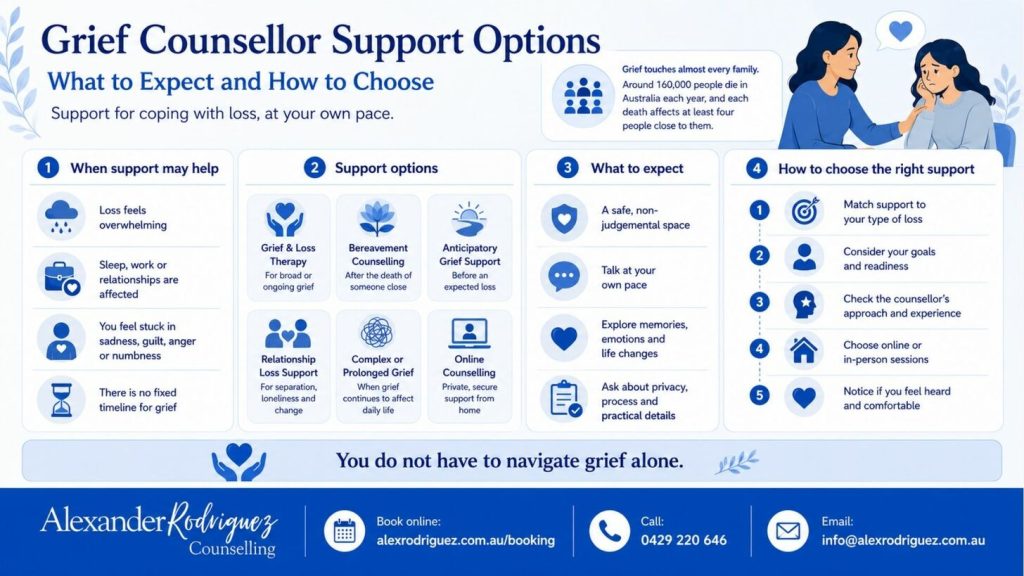
A Grief Counsellor can offer you steady, professional support when a loss changes your world. Grief touches almost every Australian family at some point. Each year, around 160,000 people die across Australia, and it’s estimated that each death affects at least four people close to them.
That means hundreds of thousands of Australians are coping with loss at any given time, whether it happened recently or years ago. Grief counselling is not a one-size-fits-all process. Your experience of loss is shaped by your relationship with the person, your circumstances, and your own way of processing emotion.
Working with a Grief Counsellor gives you a safe, non-judgemental space to talk openly about what you’re going through. You don’t have to grieve alone or feel pressure to “move on” by a certain date. Bereavement support can help you understand the stages of grief, work through difficult emotions like guilt, anger, or numbness, and slowly find your footing again. Counselling and Therapy sessions grounded in genuine care and practical guidance can support you as part of a trusted mental health service for people across Sydney and Parramatta. Whether you’re facing sudden loss or grief that has lingered longer than expected, support is available at your own pace.
You don’t have to navigate grief on your own. Reaching out for support, whenever you feel ready, can be an important step towards feeling more like yourself again. Book a consultation with Alex Rodriguez to discuss the right grief and bereavement support for your needs. You can call 1300 467 513 or email info@alexrodriguez.com.au to enquire about available services or book your appointment online to get started at a time that suits you.




Alexander Rodriguez
Seize the Day, Book an Appointment Today
Reach out anytime. Book online, call us, or visit our office in person.
Key Takeaways
- Grief affects everyone differently, with no fixed timeline for healing.
- A Grief Counsellor offers a safe space to process loss at your own pace.
- Coping with loss can involve death, relationship breakdown, or anticipatory grief.
- Bereavement support and grief counselling are available online or in person.
- Reach out by phone, email, or online booking when you’re ready.
Understanding Grief Counselling and When It May Help
When life changes suddenly, finding a safe space to process your emotions is important. A Grief Counsellor can help you work through the ways loss has affected your mind, body, and daily routine. Coping with loss is rarely straightforward. Some days may feel manageable, while others bring emotions that seem to come out of nowhere. This is a normal part of grieving, and it does not mean something is wrong with you. Grief counselling offers you a structured, supportive space to talk through these ups and downs with someone trained to listen without judgement.
Many people wait until grief starts affecting their sleep, relationships, or work before reaching out for help, but support can be useful at any point in the process. Understanding the stages of grief, such as denial, anger, bargaining, sadness, and acceptance, can help you make sense of what you’re feeling, even though grief rarely moves through these stages in a straight line. Bereavement support is not about rushing you towards “moving on.” Instead, it focuses on helping you carry your loss in a way that still allows you to live, connect, and function day to day. As part of a broader Counselling and Therapy approach, and grounded in the values of a trusted mental health service, this kind of support is designed to meet you where you are, whether your loss happened last week or several years ago.
How grief counselling can support coping with loss
A professional Grief Counsellor offers a confidential space to explore your feelings. Through grief counselling, you learn to navigate the complex waves of sorrow. This support helps you integrate your experience into your life story while keeping your sense of self.
Common emotional, physical, and practical responses to grief
Grief can surprise you with its many reactions. You might feel intense sadness, anger, guilt, or numbness. You could also experience changes in sleep, fatigue, or unexplained aches. Or you might struggle to concentrate at work or manage daily tasks.
- Emotional: Feelings of intense sadness, anger, guilt, or numbness.
- Physical: Changes in sleep patterns, fatigue, or unexplained aches.
- Practical: Difficulty concentrating at work or managing daily household responsibilities.
Why the stages of grief are not a fixed pathway
Many believe grief follows a linear progression. But the stages of grief are not a fixed pathway. You might move back and forth between emotions or experience them in an unexpected order. Your unique experience is valid, and there’s no “right” way to heal.
When additional bereavement support may be helpful
Sometimes, the weight of loss feels too heavy to carry alone. Seeking bereavement support is helpful when grief is intense or interferes with daily life. If loss impacts your work, relationships, or self-care, a professional can offer the stability you need to move forward.
What to Expect When You See a Grief Counsellor
Dealing with loss is deeply personal, and your first meeting is about respecting that journey at your own pace. It’s normal to feel unsure about what happens next, whether you’ve never spoken to a counsellor before or you’re returning to grief counselling after some time. Knowing what to expect can make that first step feel less daunting. Your initial session is generally an opportunity to share your story in your own words, at your own speed, without pressure to explain everything at once.
From there, a Grief Counsellor will work with you to understand your circumstances, your support networks, and what coping with loss looks like for you day-to-day. This might involve talking through the stages of grief, identifying triggers that bring up difficult emotions, or simply having a consistent space to check in each week. Sessions are shaped around your needs rather than a fixed script, and bereavement support can continue for as long as it feels helpful, whether that’s a few sessions or an ongoing part of your Counselling and Therapy. As with any mental health service, the goal is to help you feel heard, supported, and better equipped to manage your grief over ti
What may happen during your first counselling session
Your first session is about building a connection and understanding your story. A Grief Counsellor will ask you to share what’s been happening in your life. They want to know how you’ve been coping since your loss.
This isn’t a clinical interrogation. It’s a safe space for you to express your needs and concerns. You might talk about physical or emotional changes you’ve noticed lately. This helps your counsellor better understand your grief, so they can support you effectively.
How counselling and therapy can be tailored to your needs
Healing looks different for everyone, which is why Counselling and Therapy should never follow a fixed script. Sessions can be shaped around your goals, your pace, and what feels most helpful to you. You are the expert on your own life, and your input shapes the direction of each session.
A Grief Counsellor can adjust their approach depending on whether you need practical strategies for coping with loss, support through the stages of grief, or simply space to talk. Whether you’re looking for short term bereavement support or an ongoing part of your mental health service journey, sessions are built around what works for you.
Talking about memories, emotions, and difficult changes at your pace
You’re always in control of what you share. If you’re not ready to discuss certain memories or emotions, that’s okay. You can explore these topics when you feel safe and ready.
This grief counselling approach means you never feel rushed. Whether you need to tackle daily challenges or process deep emotions, the session adapts to your comfort level.
Privacy, professional boundaries, and your right to ask questions
Keeping your sessions private and safe is a priority. Your counsellor will explain the boundaries that ensure confidentiality. You’re encouraged to ask any questions about the process, techniques, or your support plan.
| Aspect | Expectation | Reality |
|---|---|---|
| Session Pace | Fixed and rigid | Flexible and client-led |
| Topics | Forced disclosure | Your choice |
| Goal Setting | Generic advice | Personalised support |
| Environment | Clinical/Cold | Safe and empathetic |
Understanding these aspects can make you feel more confident about your grief counselling journey. Remember, this mental health service is here to support you. Your comfort is the most important part of the counselling and therapy experience.
Grief Counsellor Support Options for Different Experiences of Loss
Dealing with loss is unique for everyone, and there’s no one-size-fits-all way to heal. Some people are grieving the death of a parent, partner, child, or close friend, while others are coping with the loss of a pet, a relationship, or a significant life change. A Grief Counsellor understands that each of these experiences deserves its own space and its own pace of healing. Remember, the stages of grief are not a fixed path you move through in order. Your feelings are valid, whatever they look like and however long they last.
Because grief shows up differently for everyone, grief counselling can be shaped around your specific situation, whether you’re dealing with a sudden or traumatic loss, an anticipated death after illness, or grief that has resurfaced after many years. Some people benefit from short-term support during a difficult period, while others prefer ongoing sessions as life continues to change around them. The aim is always to meet you where you are rather than expect you to fit a particular timeline.
Grief and Loss Therapy for broad or ongoing grief concerns
Some grief does not resolve quickly, and that is a normal part of the healing process for many people. If your loss has been lingering for months or years, or feels tied to other areas of your life, ongoing grief and loss therapy can offer steady, continued support. Rather than working towards a fixed end point, sessions can adapt as your needs change over time.
How therapy may help you process emotions and adjust to change
Grief counselling offers a safe space to explore your feelings. It helps you integrate your loss into your life story. You’ll learn to manage daily life while honouring your emotions.
Bereavement Counselling after someone close to you has died
Losing someone close to you, whether a parent, partner, child, sibling, or close friend, can bring on a wide range of emotions that feel difficult to manage alone. Bereavement counselling offers a space to process these feelings, make sense of your loss, and slowly find ways to adjust to life without that person. Support can begin whenever you feel ready, whether that’s shortly after the loss or sometime later.
Support for sadness, guilt, anger, and changes in daily life
Loss can bring intense emotions like sadness, guilt, or anger. Alex Rodriguez Counselling provides bereavement support for these feelings. A Grief Counsellor helps you adjust to life’s changes after a loss.
Anticipatory Grief Support before an expected loss
Grief does not always begin after a death. When someone close to you is living with a serious illness or nearing the end of life, you may already start to feel sadness, worry, or a sense of loss beforehand. This is known as anticipatory grief, and it’s a normal response to an expected loss. Support during this time can help you process these feelings while still being present for your loved one.
Making space for uncertainty, preparation, and emotional connection
Anticipatory grief is feeling the future while living in the present. Professional counselling and therapy can help you cope with this. It allows for meaningful connection and preparation during tough times.
| Support Type | Primary Focus | Best For |
|---|---|---|
| Grief and Loss Therapy | Ongoing emotional processing | Long-term or complex grief |
| Bereavement Counselling | Immediate loss adjustment | Recent death of a loved one |
| Anticipatory Support | Preparation and connection | Expected or impending loss |
Choosing the right grief counselling depends on your needs and experience. Whether it’s immediate bereavement support or long-term guidance, a Grief Counsellor can guide you.
Support for Relationship Loss, Life Changes and Complex Grief
Even without a death, your world can feel turned upside down. Many people feel deep sadness during major life changes, such as separation or divorce, the end of a close friendship, retrenchment, moving away from home, or a significant health diagnosis. These experiences can bring on grief that feels just as real and disorienting as bereavement, even though it’s often overlooked or dismissed by others. A Grief Counsellor offers a safe space to process these feelings without judgement, whatever the cause of your loss.
Some experiences of grief are also more complex, particularly when a loss involves guilt, unresolved conflict, trauma, or multiple losses happening close together. This is sometimes referred to as complicated or prolonged grief, and it may benefit from more structured, ongoing support. Grief counselling can help you work through these layered emotions at a pace that feels manageable, rather than expecting you to “get over it” quickly. Whatever form your loss has taken, your feelings deserve to be acknowledged and supported.
Support After Relationship Loss or Separation
Ending a relationship can be very painful. It’s like mourning the future you had planned with that person.
Working through rejection, loneliness, identity changes, and co-parenting concerns
After a relationship loss, you might feel rejected or lonely. These feelings can make you question who you are. Professional help is key to rebuilding your identity and dealing with the challenges of separation.
Support for Major Life Changes and Identity Shifts
Life is always changing, and big shifts can leave you feeling lost. Whether it’s a job change or a health issue, coping with loss means accepting these changes.
Adjusting to changes in work, health, family roles, or sense of self
Changes in family roles or health can be unexpected. These changes need time to adjust to. A Grief Counsellor helps you find your way without feeling overwhelmed by the stages of grief.
Support for Complex or Prolonged Grief
At times, your sadness doesn’t lessen as you’d hope. This is called complex grief or prolonged grief, where the pain stays strong.
Recognising when grief continues to affect your wellbeing and functioning
If your feelings stop you from doing everyday things, it’s time to seek help. If you struggle to work, keep relationships, or take care of yourself, don’t face it alone. Coping with loss is a journey, and you don’t have to do it by yourself.
Online Grief Counselling with Alex Rodriguez Counselling
Alex Rodriguez Counselling offers online support so you can access grief counselling from wherever you are in Australia, whether that’s Sydney, Parramatta, or a regional area. Online sessions mean you don’t need to travel or fit around long waiting times to get support. This can be especially helpful if you’re managing grief alongside a busy schedule, mobility challenges, or simply feel more comfortable talking from home.
A Grief Counsellor can support you through video or phone sessions in much the same way as an in-person appointment, helping you work through coping with loss at your own pace. Online bereavement support still allows for the same level of care and privacy, while giving you more flexibility around when and where you connect. Whether you prefer face to face sessions or the convenience of speaking from home, the goal is to make Counselling and Therapy as accessible as possible.
How secure online sessions can make support more accessible
Technology has changed how we get mental health support. Secure video platforms let you talk to a qualified Grief Counsellor from home. These sessions are private and remove barriers that stop people from seeking help.
What you need for a private and reliable online counselling appointment
To make the most of your online grief counselling, prepare well. You’ll need a good internet connection and a device with a camera, like a laptop or tablet. Most importantly, find a quiet, private spot where you can talk freely without interruptions.
Who may benefit from online grief counselling in Australia
Many people across Australia find online counselling suits their lifestyle. It’s great for those in remote areas, with limited mobility, or very busy lives. It’s also perfect if you prefer discussing sensitive topics in your own space.
How online sessions compare with face-to-face mental health support
Online sessions offer a modern alternative to traditional face-to-face meetings. They provide the same empathy and clinical care as in-person sessions. The table below shows the main differences to help you choose what’s best for you.
| Feature | Online Counselling | Face-to-Face |
|---|---|---|
| Location | Anywhere with internet | Clinic location |
| Travel Time | None | Required |
| Environment | Your own home | Professional office |
| Accessibility | High | Moderate |
Choosing the right path for your healing is a personal decision. Whether you prefer online or in-person, the most important thing is to seek support. Alex Rodriguez Counselling is here to support you with compassion and expertise.
How to Choose the Right Grief Counselling Option for You
Finding a place where your loss is understood and valued is important. With so many grief support options available, from support groups to psychologists to counsellors, it can feel overwhelming to know where to start. Choosing the right one often comes down to what feels safe and manageable for you right now.
When looking for a Grief Counsellor, it can help to consider a few practical things. Do you prefer one-on-one sessions or a group setting? Would you rather meet in person or access support online? Is there a particular type of loss you’re dealing with, such as the death of a family member, a relationship breakdown, or a more complex or prolonged grief experience? Grief counselling that feels like a good fit is usually one where you feel comfortable being honest, without pressure to “perform” or move faster than feels right. It’s also worth asking about the counsellor’s experience with bereavement support and how they tailor sessions to individual needs, since coping with loss looks different for everyone. Ultimately, the right option is the one that helps you feel heard and supported as you work through your grief.
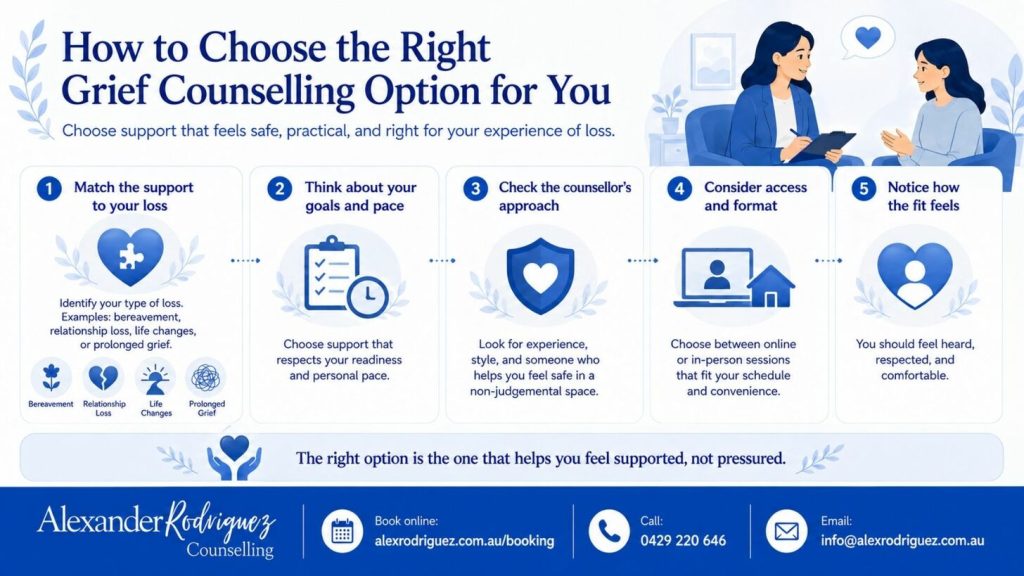
Match the service to the type of loss you are experiencing
Loss is different for everyone, and your needs can change. Whether it’s bereavement counselling after a loss or support for a big life change, make sure the service fits your needs.
Consider your goals, readiness, and preferred pace
Think about what you want to get from counselling and therapy. Some like a structured plan, while others need time to process their feelings. Choose a mental health service that respects your pace.
Check the counsellor’s approach, experience, and professional suitability
When searching for a Grief Counsellor, look at their background and style. At Alex Rodriguez Counselling, we use proven methods in a safe, non-judgemental space.
Think about accessibility, session format, location, and scheduling
Practicality is important for sticking with support. Think about whether online or face-to-face sessions work for you. Make sure the schedule fits your life to avoid extra stress.
Notice whether you feel heard, respected, and comfortable
Your initial feeling is crucial. Pay attention to whether you feel genuinely heard and safe. A top mental health service will always put your comfort first.
| Factor | What to Look For | Why It Matters |
|---|---|---|
| Specialisation | Relevant experience in your type of loss | Ensures targeted, effective support |
| Format | Online vs. In-person availability | Impacts your consistency and comfort |
| Approach | Empathetic and evidence-based methods | Builds trust and therapeutic progress |
| Connection | Feeling respected and understood | Foundation of a safe healing space |
Questions to Ask Before Choosing Grief and Loss Support
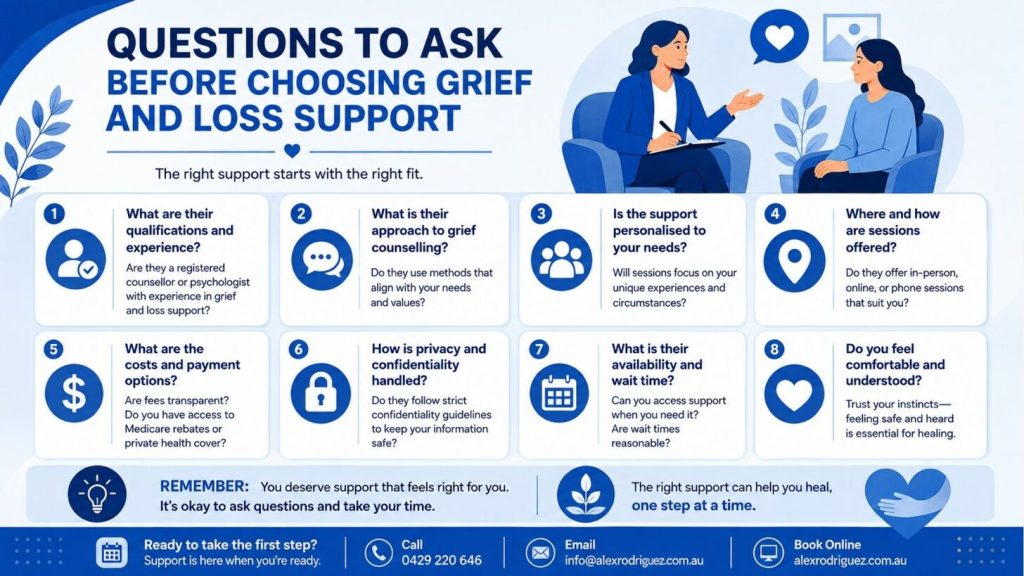
Choosing the right professional for loss support is a big step, and reaching out shows real strength and care for your own well-being. It’s completely normal to feel unsure about who to choose or what to expect, so asking a few questions upfront can help you feel more in control of the process.
Before booking a session, it may help to ask about the counsellor’s experience with bereavement support and whether they’ve worked with situations similar to yours, such as sudden loss, relationship breakdown, or complex grief. You might also ask how sessions are structured, how long support typically continues, and whether grief counselling is available online as well as in person. It’s reasonable to ask about cost, availability, and what a typical first session involves. A good Grief Counsellor will welcome these questions and take the time to explain how they can support your particular experience of coping with loss, rather than offering a one-size-fits-all approach.
Questions about counselling methods and expected outcomes
It’s okay to ask a Grief Counsellor about their approach. Find out how they tailor their counselling and therapy to you. Knowing if they use proven methods and what they aim to achieve is helpful.
Questions about session frequency, duration, and review points
Regular sessions are important for effective bereavement support. Ask how often and how long each session will be. Also, ask if there are times to review your progress and adjust your goals.
Questions about confidentiality, privacy, and online security
Your privacy is crucial in digital sessions. Ask about the security of video call platforms. A good mental health service will be open about their privacy policies.
Questions about fees, cancellations, and practical arrangements
Knowing the practical details of therapy can reduce stress. Ask about fees, payment options, and cancellation policies. This lets you focus on healing without worrying about logistics.
When to ask about referrals or additional mental health services
As your needs change, you might need different help. It’s okay to ask for referrals to other specialists. A quality mental health service will know when a team approach is best for you.
| Support Type | Primary Focus | Best For |
|---|---|---|
| Individual Therapy | Personalised healing | Deep, private processing |
| Bereavement Support Groups | Shared experience | Reducing isolation |
| Specialised Counselling | Targeted trauma work | Complex grief symptoms |
Preparing for Your First Session with Alex Rodriguez Counselling
You don’t need to have all the answers before your first session. It’s completely normal to feel a mix of emotions beforehand, whether that’s nervousness, relief, sadness, or even uncertainty about whether grief counselling is the right step for you. This time is about your well-being and healing, not about getting things “right.”
There’s no need to prepare a list of talking points or rehearse what you want to say. A Grief Counsellor will guide the conversation gently, starting with what feels most comfortable to share. It can help to think about what you’re hoping to get from support, whether that’s a space to talk openly, practical strategies for coping with loss, or help understanding the stages of grief. If it’s useful, you might jot down a few things you’d like to mention, though this isn’t essential. What matters most is showing up as you are and allowing the session to unfold at your own pace.
What to write down before your appointment
Writing a few notes can help you feel more grounded. You might note any changes in your daily routine, like sleep or appetite. Tracking these small details helps your Grief Counsellor understand how you’re managing.
How to describe what has happened and what you need now
Just share your loss story in your own words when you meet us. You don’t need to follow a specific structure. Focus on what’s hard for you now and what grief support you need.
Topics you can raise if grief is affecting sleep, work, or relationships
Grief can impact many areas of life. It’s good to talk about how it’s affecting your work or relationships. Being open about these challenges lets your counsellor offer strategies for your situation.
Why you do not need to have everything organised before seeking help
You don’t need to have your thoughts organised for your first counselling session. We help you navigate your feelings at your own pace. Seeking grief support is a big step, and we’re here to help you, no matter how you feel.
Your Grief Counsellor is there to guide you through coping with loss without judgment. You can come as you are, with all your questions and uncertainties.
Booking Grief and Loss Counselling with Alex Rodriguez Counselling
If you’re ready to seek support, Alex Rodriguez Counselling offers compassionate, personalised sessions to help you through your grief. Taking the first step towards healing is significant, and you don’t have to figure everything out before reaching out. Whether you’re looking for grief counselling after a recent loss or ongoing bereavement support for something more long-standing, help is available when you’re ready.
Services available from Alex Rodriguez Counselling
We offer a variety of specialised options to help you at your own pace. Whether it’s grief and loss counselling for a recent event or long-term support, our team is dedicated to your wellbeing.
Grief and Loss Therapy
This service provides a safe space to explore your feelings and develop healthy coping strategies.
Bereavement Counselling
Receive dedicated bereavement support after the death of a loved one. We help you navigate the complexities of mourning.
Anticipatory Grief Support
We offer guidance for those preparing for an expected loss. This allows you to find strength during a difficult transition.
Support After Relationship Loss or Separation
Healing from the end of a significant relationship takes time and understanding. Our sessions provide the support you need.
Support for Major Life Changes and Identity Shifts
Major transitions can trigger deep feelings of loss. We help you find your footing again.
Support for Complex or Prolonged Grief
If your grief feels stuck or overwhelming, our Grief Counsellor can help. We help you process these persistent emotions.
Online Grief Counselling through secure sessions
Access professional care from home through our secure, private digital platform.
How to make an enquiry or arrange an appointment
When you’re ready to book grief counselling, reaching out is simple and confidential. We encourage you to contact us to discuss how we can best support your unique path to healing.
Get in Touch
Call 1300 467 513, to speak with a member of our team about our mental health service options, or email info@alexrodriguez.com.au if you’d prefer to outline your needs in writing before we connect. You can also book grief counselling sessions at a time that suits your schedule through our secure online portal. We’re here to offer compassionate bereavement support and grief and loss counselling to help you move forward at your own pace.
Conclusion
Grief is not something you have to face alone, and there’s no right or wrong way to move through it. Reaching out to a Grief Counsellor can give you the space, understanding, and practical support you need to process your loss at your own pace. Whether you’re navigating the stages of grief after a death, adjusting to a major life change, or dealing with a more complex or prolonged experience of loss, grief counselling can help you find your way forward.
Coping with loss looks different for everyone, and the right kind of bereavement support can make a meaningful difference to how you carry that experience over time. As part of a broader Counselling and Therapy approach, and grounded in the values of a trusted mental health service, support is available whenever you feel ready to take that first step. You don’t need to have everything figured out; you just need to be willing to reach out.
You don’t have to navigate grief on your own. Reaching out for support, whenever you feel ready, can be an important step towards feeling more like yourself again. Book a consultation with Alex Rodriguez to discuss the right grief and bereavement support for your needs. You can call 0429 220 646 or email info@alexrodriguez.com.au to enquire about available services, or book your appointment online to get started at a time that suits you.