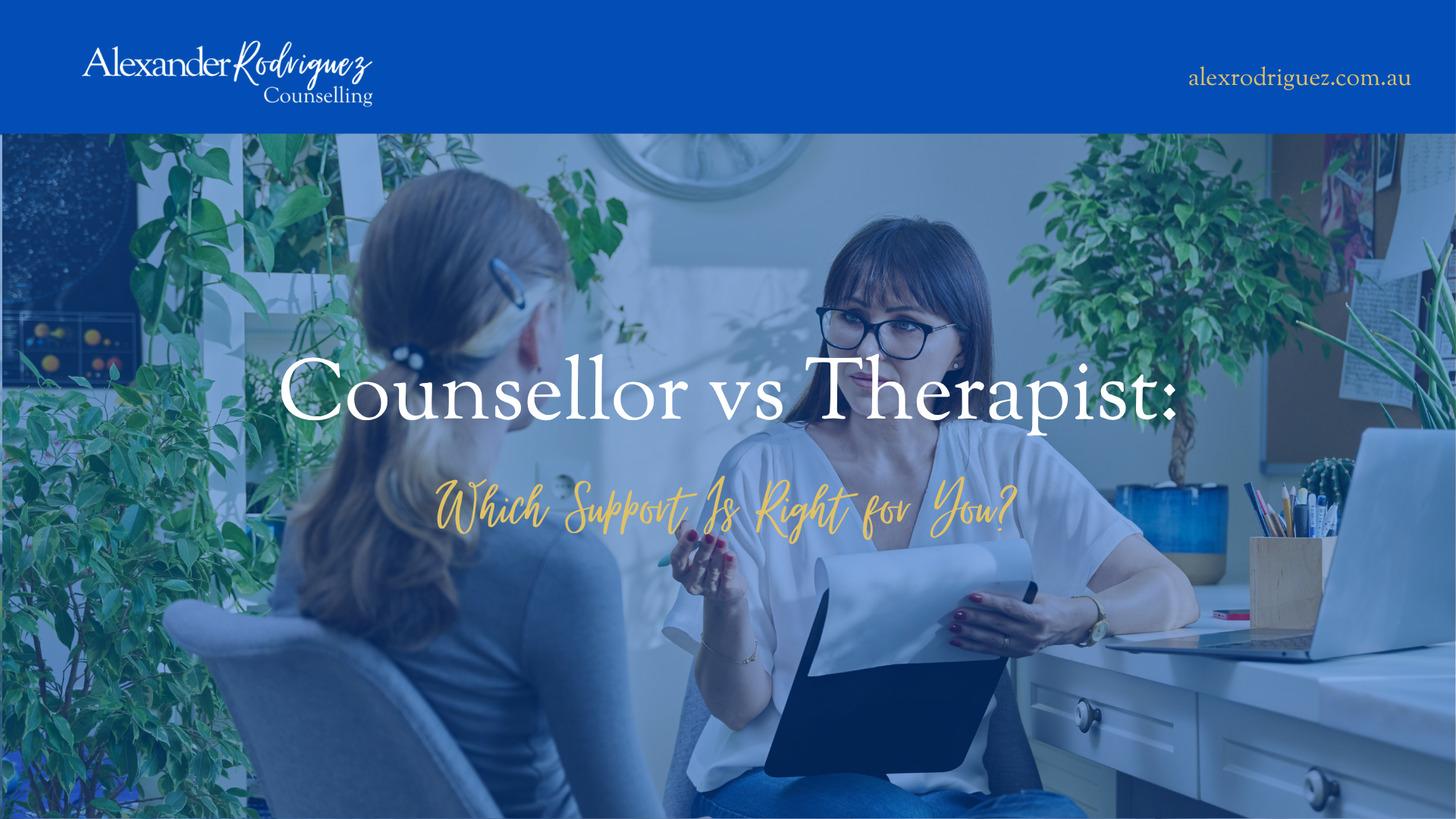
Counsellor vs Therapist: Which Support Is Right for You?
Have you ever found yourself searching for a counsellor or a therapist, only to stop and wonder what the difference actually is? You are not alone. Across Australia, more people are reaching out for mental health support, and yet many are unsure which type of professional can best support them. According to the Australian Bureau of Statistics National Study of Mental Health and Wellbeing, an estimated 1 in 5 Australians aged 16 to 85 will experience a mental disorder in any given year, with anxiety disorders affecting around 3.4 million people nationwide.
Taking that first step to seek help is something to feel good about, and understanding your options makes the journey a whole lot easier.
The truth is, both counsellors and therapists offer real, meaningful support, and the right choice simply depends on what you are going through right now. Counselling tends to focus on everyday challenges such as stress, grief, relationship difficulties, and life transitions, while therapy often takes a deeper clinical approach to longer-standing mental health concerns. Whether you are based in Parramatta, Sydney, or anywhere across Australia, knowing which type of mental health support suits your needs can save you time, reduce confusion, and help you feel confident about reaching out. This guide is here to walk you through both options clearly, so you can make the choice that feels right for you.
Ready to Take Control of Your Wellbeing?
Whether counselling or therapy feels like the right fit, personalised mental health support is just one conversation away. At Alex Rodriguez, we help you find the right support for your needs, your goals, and your lifestyle, with no pressure and no complicated process.
- Call: 0429 220 646
- Email: info@alexrodriguez.com.au
- Book online through our Booking Page
Key Takeaways
- A counsellor and a therapist have different training, focus areas, and approaches
- Counselling supports everyday challenges like stress, grief, and life transitions
- A therapist works with deeper, longer-standing mental health concerns
- You do not need a referral or diagnosis to start seeing a counsellor
- The right connection with your professional matters as much as their qualifications
- Medicare and private health insurance may help reduce your out-of-pocket costs
- If you are unsure where to start, reaching out for a conversation is always the best first step
Understanding the Landscape of Mental Health Support in Australia
Mental health support in Australia has expanded considerably over the past decade, giving everyday Australians access to a broader and more diverse range of professional care than ever before. In 2024 to 2025, around 2.8 million Australians, which is approximately 10 per cent of the population, received Medicare-subsidised mental health services, according to the Australian Institute of Health and Welfare. That is a significant number of people actively seeking support, and yet many are still unsure which type of professional to turn to first. Whether you are considering seeing a counsellor for everyday stress and personal challenges, or you are wondering whether a therapist might be better suited to what you are going through, understanding how the system works is the first step. If you have already found yourself searching for a counsellor near me or a therapist near me somewhere in Sydney or across Australia, knowing the difference between these roles will help you make a much more confident and informed decision.




Alexander Rodriguez
Seize the Day, Book an Appointment Today
Reach out anytime. Book online, call us, or visit our office in person.
The Australian allied health and mental wellbeing landscape includes a wide variety of professionals, each trained to support you in different and complementary ways. A counsellor typically helps you work through specific life challenges such as stress, grief, relationship difficulties, or major life transitions using a structured and compassionate approach. A therapist, on the other hand, often works with more complex or long-standing mental health concerns using evidence-based clinical frameworks. Beyond these two roles, you will also find psychologists, occupational therapists, and allied health professionals who each bring their own area of expertise to the table. Understanding these differences helps you choose the type of counselling or mental health support that is genuinely right for where you are in your life right now, rather than simply going with the first option that comes up in a search.
Who Are the Key Mental Health Professionals in Australia?
Here are some common types of mental health support in Australia:
- Counsellors: They use talk therapy to help with life changes and emotional issues.
- Psychologists: They assess, diagnose, and treat many mental health problems.
- Psychiatrists: These are medical doctors who focus on mental health and can prescribe medication.
- Social Workers: They look at your mental health and your social environment.
Getting to know the mental health landscape is the first step to getting the help you need. Knowing who does what can save you time. This way, you can find the best mental health support for you.
Defining the Role of a Counsellor
A counsellor is a trained professional who provides a safe, supportive, and non-judgmental space for you to talk through the challenges, emotions, and experiences that are affecting your everyday life. Unlike what many people assume, visiting a counsellor is not only for people in crisis or those dealing with serious mental health conditions. Counselling is designed to help anyone who feels stuck, overwhelmed, uncertain, or simply in need of a space to be heard and understood. Whether you are navigating a difficult relationship, processing grief or loss, managing ongoing stress, adjusting to a major life change, or struggling with low confidence and self-worth, a counsellor can work with you to explore what you are experiencing and help you develop practical strategies to move forward. The process is collaborative, meaning your counsellor works alongside you at your own pace, respecting your boundaries and focusing on what matters most to you.
Counselling draws on a range of evidence-informed approaches to support your emotional and psychological wellbeing, including talk-based therapies, behavioural techniques, mindfulness strategies, and solution-focused methods. Your counsellor will take the time to understand your unique situation before tailoring support to your specific needs and goals. This personalised approach is what makes counselling such a valuable and accessible form of mental health support for people at all stages of life. You do not need a referral or a formal diagnosis to begin. You simply need to be willing to take that first step towards understanding yourself better and creating positive change. Whether you are based in Sydney, Parramatta, or the surrounding areas, accessing compassionate and professional counselling is more straightforward than you might think, and it can make a meaningful difference to how you feel and how you move through life.
Core Focus and Therapeutic Approach
The main aim of counselling is to give you a safe place to talk about what’s happening now. It’s not about your past but about finding solutions for today.
You’ll work on finding ways to cope better. By focusing on your strengths, you can handle stress and feel more in control.
Common Issues addressed in Counselling
Many people see a counsellor when they hit a tough spot. Whether it’s a big change or feeling stuck, this help can change your life.
Here are some areas where counselling really helps:
- Dealing with grief and loss and its complex emotions.
- Working on relationship problems and improving communication.
- Handling workplace stress and avoiding burnout.
- Adjusting to big changes like a new job or moving.
The table below shows how these areas are tackled in counselling:
| Focus Area | Primary Goal | Counselling Outcome |
|---|---|---|
| Grief Support | Processing loss | Emotional acceptance |
| Relationship Issues | Better communication | Stronger connections |
| Workplace Stress | Boundary setting | Improved balance |
| Life Transitions | Adaptation | Increased confidence |
Defining the Role of a Therapist
A therapist is a trained mental health professional who works with you to explore and address deeper, more complex emotional and psychological concerns that may be affecting your daily life, relationships, and overall sense of well-being. While the term therapist is often used broadly, it generally refers to someone who uses structured, evidence-based clinical approaches to help you understand the root causes of what you are experiencing, rather than focusing solely on immediate challenges or day-to-day stress. Therapy is particularly well-suited for people who are navigating long-standing mental health concerns such as anxiety, depression, trauma, unresolved grief, post-traumatic stress, or patterns of thinking and behaviour that feel difficult to shift on your own. Rather than simply offering a space to talk, a therapist works with you in a purposeful and goal-oriented way, using frameworks such as Cognitive Behavioural Therapy, Acceptance and Commitment Therapy, or trauma-informed approaches to help you better understand yourself and develop lasting strategies for change.
What makes therapy such a powerful form of mental health support is its depth and clinical structure. Your therapist will typically begin by taking time to understand your history, your current concerns, and what you hope to achieve through the process. From there, sessions are guided by a clear therapeutic framework that is tailored to your individual needs and adjusted as your progress develops over time. This is not a one-size-fits-all approach. It is a collaborative and personalised process that respects your pace, your experiences, and your goals. Whether you are dealing with something that has built up over many years or a more recent experience that has had a significant impact on your mental health, working with a therapist can provide you with the insight, tools, and mental health support needed to move forward with greater clarity and confidence. If you are based in Sydney, Parramatta, or the surrounding areas, professional therapy is accessible and can be a genuinely life-changing investment in your long-term wellbeing.
Specialised Training and Clinical Depth
A therapist has a lot of education and training. It’s more than just general support. They learn to spot and fix deep psychological patterns that affect your life.
Years of practice help them manage complex mental health conditions. They offer care that’s based on science and fits your unique situation.
When to Seek Long-Term Therapeutic Support
Think about seeing a therapist if you face ongoing issues. They offer a long-term solution, not just a quick fix. This is for dealing with long-lasting trauma or emotional problems.
Long-term therapy is highly effective for finding the reasons behind your actions. If you need ongoing support to change, a therapist is the right choice for you.
Key Differences Between a Counsellor and a Therapist
While both a counsellor and a therapist are trained to support your emotional well-being, the key difference lies in the depth, focus, and clinical framework of the support they provide. A counsellor typically works with you on present-day challenges and life experiences such as stress, grief, relationship difficulties, major transitions, and personal growth. The focus is on helping you develop clarity, coping strategies, and practical tools to manage what you are currently going through. A therapist, on the other hand, tends to work with deeper, longer-standing concerns that may be rooted in past experiences, patterns of thinking, or complex emotional and psychological conditions. The work is often more structured and clinical in nature, drawing on specific evidence-based frameworks designed to address the underlying causes of distress rather than just the surface-level symptoms.
Another important difference between a counsellor and a therapist is the level of training and the types of concerns each professional is best suited to support. A counsellor may work across a broad range of emotional and personal challenges without requiring a formal mental health diagnosis to begin. A therapist often has additional clinical training and works with more complex presentations that benefit from a longer-term, structured approach. That said, neither role is better than the other. The right choice simply depends on what you are experiencing and what type of support feels most aligned with your needs right now. If you are unsure which direction to take, reaching out for an initial conversation is always a great place to start.

Educational Background and Qualifications
A counsellor usually has a diploma or degree in communication and support. In Australia, many are registered with the Australian Counselling Association (ACA) or the Psychotherapy and Counselling Federation of Australia (PACFA).
A therapist, like a psychologist or social worker, has more university training. They study for at least six years and get supervised practice. This meets the Australian Health Practitioner Regulation Agency (AHPRA) standards.
Scope of Practice and Clinical Focus
A counsellor focuses on short-term solutions. They help with life changes, relationship issues, or stress. They give you tools to manage daily life.
A therapist takes a deeper, clinical approach. They explore long-term patterns or serious mental health issues. Their training lets them tackle severe symptoms with evidence-based methods.
Choosing between a counsellor and a therapist depends on your needs. Do you need help with a current issue or a deeper mental health exploration? Both offer valuable guidance, but pick the one that fits your situation best.
How to Choose the Right Professional for Your Needs
Choosing between a counsellor and a therapist does not have to feel overwhelming, and the best place to start is simply by reflecting on what you are currently going through and what kind of support feels right for you. If you are navigating everyday stress, a life transition, relationship difficulties, grief, or a general sense of feeling stuck, working with a counsellor is often a very practical and accessible first step. A counsellor provides a warm, supportive space where you can talk through your experiences, gain clarity, and develop strategies to help you move forward with greater confidence. On the other hand, if you have been experiencing longer-standing emotional or psychological concerns, recurring patterns of thinking or behaviour that feel hard to shift, or conditions such as anxiety, depression, or trauma, a therapist may be better suited to provide the structured, clinically informed support you need. There is no right or wrong answer here. What matters most is that you feel comfortable with the professional you choose and that the support they offer genuinely aligns with where you are in your wellbeing journey right now.
If you are still unsure after reflecting on your needs, that is completely okay and far more common than you might think. Many people begin their search by looking for a counsellor or therapist without being certain which direction to take, and that is a perfectly reasonable starting point. A good first step is to reach out to a professional for an initial conversation to help you understand your options and guide you towards the most appropriate type of mental health support for your situation.
Assessing Your Current Mental Health Goals
Before you book an appointment, think about what you want to achieve. Do you need practical strategies for daily stress, or to work through deep emotional issues? Knowing your main goal helps you find the right support.
Think about whether you’re going through big changes, like a career shift or relationship issues. If you’re looking for quick solutions, a counsellor might be best. But for deeper personal growth, a therapist could be more suitable.
Considering the Severity of Your Symptoms
The level of your symptoms is key in choosing support. For mild, situational issues, brief sessions might help. These focus on building resilience and healthy coping.
If you face more serious or ongoing mental health challenges, a clinical approach is better. Professional guidance from a therapist can help manage chronic symptoms safely. Always put your safety and well-being first when deciding on care.
| Goal Type | Primary Focus | Recommended Support |
|---|---|---|
| Situational Stress | Immediate coping skills | Counsellor |
| Personal Growth | Self-awareness and patterns | Therapist |
| Complex Symptoms | Clinical intervention | Clinical Psychologist |
| Relationship Issues | Communication and conflict | Counsellor or Therapist |
Understanding Mental Health Support in Australia
Getting the right mental health support in Australia becomes much simpler when you understand how the system works and what financial help is available to you. You can access both public and private options, depending on your needs and budget. Through Medicare, you may be eligible for subsidised sessions with a counsellor or Therapist under a Mental Health Treatment Plan from your GP. This can make counselling far more affordable and easier to commit to long-term. If you have private health insurance, you might also get rebates when you see a Therapist, which gives you more flexibility when searching for a therapist or a counsellor.
It’s also worth knowing that public services, such as community health centres, often provide low-cost or free mental health support, though there may be wait times. On the other hand, private practitioners can offer faster access but typically cost more per session. Understanding these options means you can choose what fits your situation best without feeling overwhelmed by costs. Whether you’re reaching out to a counsellor for short-term guidance or working with a Therapist on deeper concerns, knowing how to navigate the system helps you focus on what really matters, which is your wellbeing.

Medicare Rebates and Mental Health Care Plans
The Australian Government provides financial support for mental health services through the Better Access initiative, which allows eligible Australians to access Medicare rebates for a set number of sessions with a registered mental health professional each year. This can make mental health support significantly more affordable, whether you are seeing a counsellor, a therapist, or another allied health professional. The first step is visiting your General Practitioner (GP), who can assess your needs and, where appropriate, create a formal Mental Health Care Plan on your behalf. This plan is what makes you eligible to claim Medicare rebates on your sessions, reducing your out-of-pocket costs and making it easier to access the right support without financial pressure.
Here is how the process generally works:
- Book a longer GP appointment so you have enough time to discuss your mental health concerns in full
- Ask your GP to assess your eligibility for a formal Mental Health Care Plan
- Confirm that your chosen counsellor or therapist is registered and accepts Medicare rebates
- After each session, submit your receipt to Medicare through the Express Plus Medicare app, online via myGov, or at your nearest Services Australia centre
It is always a good idea to confirm current session limits and rebate amounts directly with your GP or Medicare, as these details can be updated by the Australian Government from time to time.
Private Health Insurance and Out-of-Pocket Costs
If you hold private health insurance, your extras cover may include benefits towards sessions with a registered counsellor or therapist, depending on your policy and fund. Cover levels vary considerably between insurers, so it is always worth checking directly with your provider before booking to confirm what is included and what your annual limits are.
A few practical things to keep in mind:
- You cannot claim both a Medicare rebate and a private health insurance benefit for the same session
- You may still have a gap fee to pay, which is the difference between the full session fee and your rebate or benefit
- Always ask about fees upfront so there are no surprises
- If cost is a concern, contact our team, and we can help you explore your options
How Alex Rodriguez Counselling and Therapy Can Help You
At Alex Rodriguez Counselling and Therapy, we understand that reaching out for mental health support can feel like a big step, and we want you to know that you do not have to have everything figured out before you get in touch. Whether you have been searching for a counsellor near me or a therapist near me, our team is here to make the process of finding the right support as simple, welcoming, and stress-free as possible. We offer a warm, personalised approach that begins from your very first conversation with us, taking the time to truly listen to what you are going through and helping you understand which type of support is best suited to your needs, your goals, and your lifestyle. Whether you are dealing with everyday stress, relationship challenges, grief, anxiety, low confidence, or something that has been building up for a long time, Alex Rodriguez Counselling and Therapy has the experience, the compassion, and the commitment to help you move forward in a way that feels right for you.
Our team of qualified and experienced professionals provides a broad range of mental health support services, including counselling, therapy, occupational therapy, life coaching, and allied health support, all designed to meet you where you are and support you at every stage of your wellbeing journey. Based in Sydney and Parramatta, with flexible online sessions also available, Our Counselling and Therapy is accessible to people across greater Sydney and surrounding areas who are looking for genuine, personalised, and compassionate support. You do not need a formal referral or a diagnosis to get started. Simply reach out to our team, share a little about what you are experiencing, and we will guide you towards the right type of support with clarity, care, and no pressure whatsoever. Taking that first step towards better well-being is one of the most important things you can do for yourself.
Using Online Directories for a Counsellor Near Me
Online directories are a great place to start. Sites like Psychology Today or the Counselling Directory let you search by location and more. You can find a counsellor near me easily.
These sites show detailed profiles of counsellors. You can see their qualifications and how they work. This helps you feel sure before you contact them for a first meeting.
Searching for a Therapist Near Me via Professional Bodies
Want to check credentials through official channels? Look through professional associations. In Australia, the Psychotherapy and Counselling Federation of Australia (PACFA) or the Australian Association of Social Workers (AASW) have lists of approved members.
By searching through these official sites, you know the therapist meets high standards. They keep up with new practices. Choosing an accredited professional means you’re in good hands.
| Search Method | Primary Benefit | Best For |
|---|---|---|
| Online Directories | User-friendly filters | Quick, local results |
| Professional Bodies | Verified credentials | High-standard assurance |
| GP Referrals | Medicare eligibility | Budget-conscious care |
What to Expect During Your First Session
Walking into your first session with a counsellor or therapist can feel nerve-wracking, and that is completely understandable. Most people are unsure what to say, how much to share, or whether they will feel comfortable enough to open up, and a good professional will always be aware of this from the moment you arrive. Your first session is not about having all the answers or knowing exactly what you need. It is simply an opportunity to introduce yourself, share a little about what has been going on for you, and get a genuine feel for whether this particular counsellor or therapist is the right fit for your needs. There are no tests, no pressure, and no expectation that you will walk in with everything figured out. A skilled professional will guide the conversation gently, help you feel at ease, and create a space where you feel safe enough to be honest about what you have been experiencing.
During your first session, your counsellor or therapist will typically ask some open and gentle questions about what has brought you in, what you have been going through, and what you are hoping to get out of the support process. This helps them build a clearer picture of your situation and begin thinking about the most appropriate and helpful approach for your needs. You are always in control of how much you share and at what pace, and a good professional will never push you beyond what feels comfortable or manageable. By the end of your first session, you should have a much clearer sense of what working together might look like going forward, what the next steps could be, and whether the mental health support on offer feels right for where you are right now. It is also completely okay if the first professional you see does not feel like the perfect fit. Finding the right person is part of the journey, and taking that first step is always worthwhile.
Preparing for Your Initial Consultation
Getting ready can make you feel less anxious and help you get the most out of your time. Write down why you want help now. Being clear about your goals helps the therapist understand you faster.
Also, bring a list of any medicines you’re taking or past experiences with mental health services. Don’t worry about sharing your whole life story right away. Just talk about the main issues that brought you here today.
Questions to Ask to Determine Compatibility
Finding the right therapist is a personal journey, and you should ask questions to make sure it’s a good match. You should feel free to ask about their experience with your concerns and how they treat patients. A good therapist will be happy to answer these questions because it shows you’re involved.
Here are some questions to ask during your first session:
- How do you typically approach the issues I am facing?
- What does a standard treatment plan look like for someone with my goals?
- How will we measure progress throughout our sessions?
- What is your policy on communication between appointments?
The table below shows how getting ready can make your first session with your therapist more effective.
| Preparation Step | Expected Outcome | Benefit to You |
|---|---|---|
| Drafting key goals | Clearer communication | Saves time and focus |
| Listing symptoms | Accurate assessment | Better treatment plan |
| Preparing questions | Increased confidence | Stronger professional bond |
| Reviewing history | Contextual understanding | More tailored support |
Your comfort is key in building a good relationship with your therapist. Trust your feelings during this first meeting. A strong connection is the base of effective care.
The Importance of the Therapeutic Alliance
One of the most powerful and often underestimated factors in effective mental health support is the quality of the relationship between you and your counsellor or therapist. This relationship is known as the therapeutic alliance, and decades of research in psychology and allied health consistently show that it is one of the strongest predictors of positive outcomes in both counselling and therapy, often more influential than the specific technique or approach being used. In straightforward terms, the therapeutic alliance refers to the sense of trust, safety, collaboration, and genuine mutual understanding that develops between you and your counsellor or therapist over the course of your sessions together. When this connection feels strong, you are naturally more comfortable opening up, engaging honestly with the process, and working towards meaningful and lasting change. It is not simply about finding someone with the right qualifications, although experience and training are absolutely important. It is about finding a professional whose communication style, values, and overall approach feel genuinely aligned with who you are, what you are going through, and what you need from the support you receive.
Building a strong therapeutic alliance takes a little time, and it is something that develops gradually as trust grows between you and your counsellor or therapist. In your early sessions, it is completely normal to feel a little guarded or unsure, and a skilled professional will always be patient, respectful, and sensitive to your pace. If at any point the connection does not feel right, it is important to know that this does not mean mental health support is not right for you. It may simply mean that a different professional or a slightly different approach could be a better fit for your needs and personality. Feeling comfortable enough to be honest with your counsellor or therapist is not a luxury. It is a genuine necessity for the support process to be as effective and meaningful as possible. Trusting your instincts about the relationship is just as important as trusting the process itself, and finding the right fit is always worth taking the time to get it right.
Why Connection Matters More Than Credentials
Professional qualifications are important, but they’re not everything. Even with years of experience, if you don’t feel safe, progress will be hard. Genuine rapport lets you share openly without fear of judgment.
Creating a strong connection is crucial for healing. Good mental health support is a partnership. Trust between you and your therapist makes all the difference.
Recognising When a Professional Is Not the Right Fit
It’s okay if you don’t click with a therapist. You shouldn’t stay if you don’t feel progress or comfort. Advocating for your own well-being is important.
Look out for signs like feeling ignored or pressured. If sessions leave you feeling drained, it’s time to find someone else. You deserve a therapist who shares your values.
| Feature | Healthy Alliance | Signs of Mismatch |
|---|---|---|
| Communication | Open and honest | You feel silenced |
| Comfort Level | Safe and secure | Anxious or judged |
| Goal Alignment | Shared vision | Conflicting priorities |
| Progress | Consistent growth | Stagnation or confusion |
Common Myths About Mental Health Support
One of the biggest barriers stopping Australians from seeking mental health support is the weight of common myths around counselling and therapy. Many people believe that seeing a counsellor or therapist is only necessary when things have reached a crisis point, or that asking for help is somehow a sign of weakness. The truth is that reaching out is one of the most self-aware and courageous things you can do for yourself, no matter how big or small your challenges may feel. Counselling is not just for people with serious mental health conditions. A counsellor can support anyone who feels overwhelmed, stuck, or simply in need of a safe and compassionate space to talk things through.
Another common misconception is that searching for a counsellor near me or a therapist near me means committing to a long and complicated process. In reality, mental health support is flexible, accessible, and always tailored to your individual needs and pace. Many people find that even a small number of counselling sessions can make a meaningful difference to how they feel day to day. A skilled therapist or counsellor will never push you beyond what feels comfortable, and sessions are always focused on what feels safe and manageable for you at every step.
Debunking Misconceptions About Counselling
Many think counselling is only for big crises. But it’s also for dealing with daily stress, improving communication, or finding clarity. You don’t have to be in a crisis to get help.
Another myth is that counsellors tell you what to do. But they help you find your own solutions. Here are some myths and the truth:
- Myth: You only need help if you have a diagnosed condition.
- Reality: Seeking support is for personal growth and emotional care.
- Myth: It’s a sign of failure to need someone to talk to.
- Reality: It takes courage to face your challenges.
Clarifying the Stigma Surrounding Therapy
Some people see seeking mental health support as a weakness. But it’s actually a sign of strength. It shows you’re committed to your well-being.
By talking openly about therapy, you help break down the stigma. Remember, your mental health is as important as your physical health. Taking care of your emotions is key to a balanced life.
| Myth | The Reality |
|---|---|
| Therapy is for the “weak” | Therapy is for the self-aware |
| It takes years to see results | Many find relief in just a few sessions |
| Counselling is too expensive | Medicare and insurance make it accessible |
Conclusion
Choosing to reach out for mental health support is one of the most meaningful and courageous decisions you can make for yourself, and you should feel genuinely proud for taking the time to understand your options. Throughout this guide, you have learned the key differences between a counsellor and a therapist, how the Australian mental health system works, what to consider when choosing the right professional, and how practical pathways like Medicare and private health insurance can make support more accessible. Armed with this knowledge, you are now in a much stronger position to make a confident and informed decision about the type of counselling or therapy that best suits where you are in your life right now. Remember, there is no single right answer. What matters most is that the support you choose feels right for you, your needs, and your goals.
Your wellbeing journey is entirely your own, and it does not have to follow a specific timeline or look a certain way. Whether you are just beginning to explore your options, have been searching for a counsellor near me or a therapist near me for a while, or are ready to book your first session today, the most important step is simply taking that next one.
Ready to Take Control of Your Wellbeing?
Whether counselling or therapy feels like the right fit, personalised mental health support is just one conversation away. At Alex Rodriguez Allied Health, we help you find the right support for your needs, your goals, and your lifestyle, with no pressure and no complicated process.
Reach out today across Sydney, Parramatta, and surrounding areas, with flexible online sessions also available.
- Call: 0429 220 646
- Email: info@alexrodriguez.com.au
- Book online through our Booking Page