AI and Job Security: How Career Counselling Future-Proofs Your Career
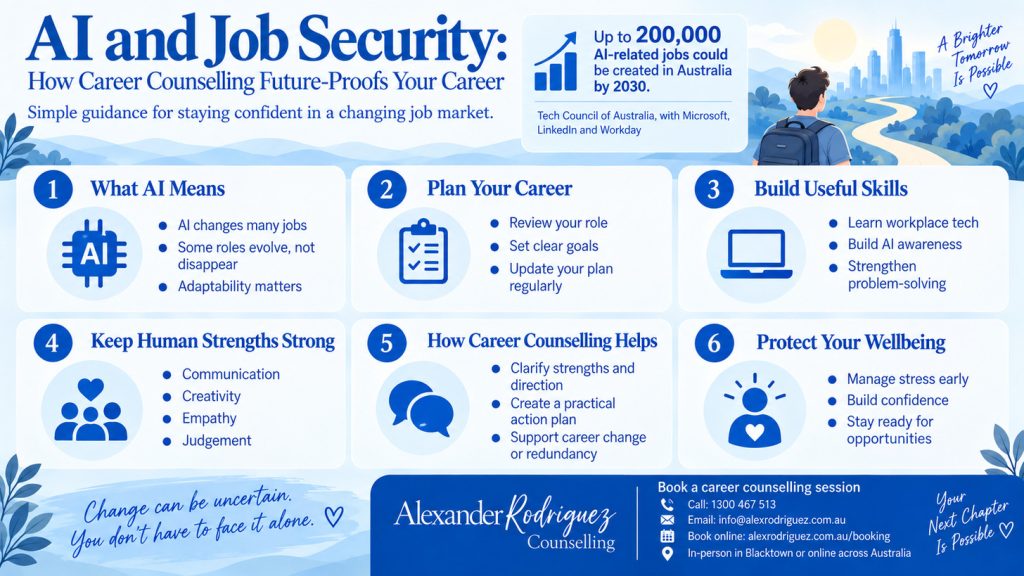
Career counselling can help you feel steadier and more confident when new technology keeps changing the way Australians work. If you’re worried about AI replacing jobs, you’re not alone, and it’s a completely understandable concern. Many people are asking what job security really looks like as artificial intelligence reshapes entire industries. According to a 2024 report by the Tech Council of Australia, supported by Microsoft, LinkedIn, and Workday, artificial intelligence could create up to 200,000 new AI-related jobs across Australia by 2030. This shows that AI isn’t really about wiping out work altogether. It’s about how well you adapt, plan ahead, and build the right skills for what’s coming next.
This is where working with a trusted Counselling Service that understands career change can make a real difference. Career counselling gives you the space to work through uncertainty, build a genuinely future-proof career plan, and understand which AI skills for jobs are becoming most valuable in your industry. Rather than reacting to change with worry, you can approach the future of work with a clear, practical, step by step plan. Thoughtful career planning now can help you feel more prepared, more capable, and more in control of your next move, no matter how the workplace continues to shift around you.
You don’t have to navigate career uncertainty, workplace stress, or life’s challenges on your own. Alex Rodriguez offers personalised, professional support designed to help you feel more confident, more capable, and more in control of your next move, with flexible in-person and telehealth options available across Sydney and Parramatta. Call 1300 467 513, email info@alexrodriguez.com.au, or book an appointment online at a time that suits you.




Alexander Rodriguez
Seize the Day, Book an Appointment Today
Reach out anytime. Book online, call us, or visit our office in person.
Key Takeaways
- AI changes jobs more than it replaces them.
- Career planning helps you adapt with confidence, not panic.
- Building AI skills for jobs matters, but human strengths still count.
- Career counselling offers clear support through redundancy, change, or uncertainty.
- Protecting your wellbeing is as important as building new skills.
Understand What AI Job Security Means for Your Career
Rapid technology change can make career planning feel overwhelming, especially when it seems like every week brings a new headline about AI replacing jobs. You may find yourself wondering how new tools and systems will affect your daily tasks, your industry, and your long-term prospects, and it is completely understandable to want some clarity around this. Rather than trying to work through these questions alone, career counselling offers a safe, supportive place to talk through these concerns openly and without judgement.
A trusted Counselling Service can help you unpack what change actually means for your specific role, rather than relying on broad predictions that may not apply to your situation. Together, you can build a clear, practical plan that strengthens your job security, identifies which AI skills for jobs are genuinely worth developing, and helps you approach the future of work with steady confidence rather than uncertainty. Over time, this process can support you in shaping a genuinely future-proof career, one that reflects your own strengths, goals, and circumstances.
Separate AI Replacing Jobs from AI Changing Jobs
You must separate AI replacing jobs from AI changing how we work. Some routine tasks are automated, but most roles are changing rather than disappearing. Your core professional value can remain strong, even when your tools change.
Reviewing your responsibilities shows which tasks machines can handle and which need your human touch. This view supports AI job security by directing you towards valuable work machines cannot copy.
Recognise the Australian Future of Work Landscape
In Australia, the future of work is moving towards digital skills and flexible service delivery. In healthcare, finance, and education, technology is opening new paths for growth. Knowing these trends can help you become a forward-thinking professional.
Think about how your sector is responding to these national changes. Local industry updates can help you spot needs before they become urgent. This active approach supports modern career management.
Identify How Automation May Affect Your Industry and Role
Automation affects each profession differently. To assess your risks, examine your daily work and your employer’s systems. The table below shows how sectors are experiencing these changes.
| Industry Sector | Automation Focus | Human-Centric Value |
|---|---|---|
| Administrative Support | Data entry and scheduling | Complex problem solving |
| Customer Service | Basic inquiry responses | Empathy and conflict resolution |
| Professional Services | Report generation | Strategic decision-making |
| Creative Industries | Drafting and layout | Originality and vision |
Focus on Adaptability Rather Than Predicting Every Change
Trying to predict every technology change can waste effort. Build adaptability as a core skill instead. Flexibility helps you change direction as the future of work evolves.
Remember, AI replacing jobs is often a fear-based story, not reality. Continuous learning strengthens your AI job security and keeps you valuable in changing workplaces. Your ability to learn and use new knowledge is your greatest competitive advantage.
Follow a Practical Career Planning Process
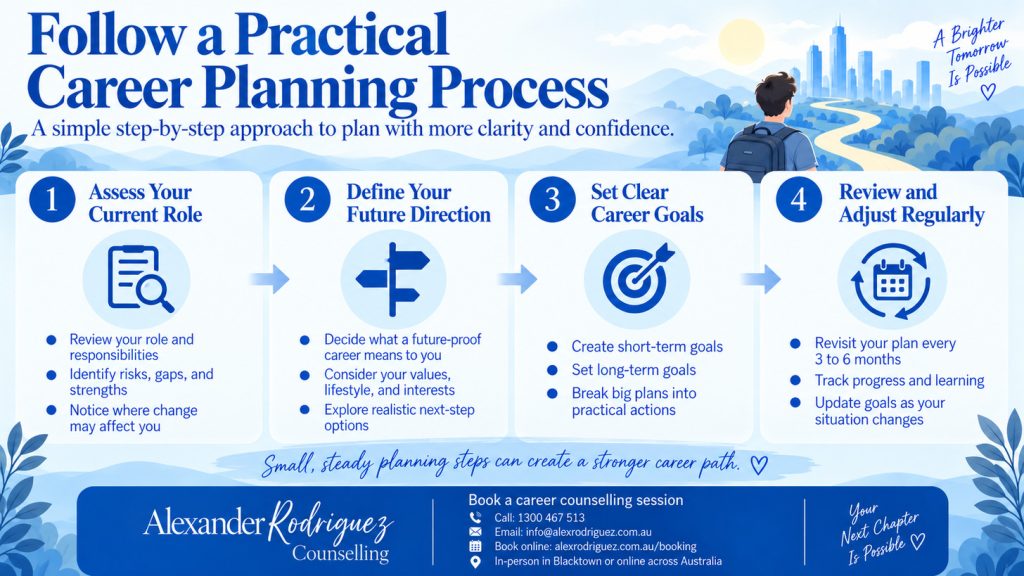
You can guide your professional future with a repeatable, practical career planning process, rather than trying to figure everything out at once. Instead of fearing rapid technological shifts or reacting to every new headline about the workplace, it helps to break your development into small, manageable steps that you can work through one at a time. This might involve reviewing your current skills, identifying gaps, setting realistic short-term goals, and checking in regularly to see what is working and what needs adjusting.
Working through these steps consistently, rather than all at once, can help you build lasting job security over time, while still leaving room to adapt your plan as your industry, circumstances, and priorities continue to change.
Step One: Assess Your Current Role and Employment Risks
Start by reviewing your daily tasks and noting which ones are highly repetitive. Automation often targets routine processes. Spotting these areas early helps you shift towards work needing uniquely human skills, such as empathy, complex judgement, and creative problem-solving.
Step Two: Define the Type of Future-Proof Career You Want
After understanding your risks, focus on the value you bring to your organisation. Reflect on your core strengths and how you can use them in an evolving workplace. This clarity moves you from fear towards a proactive strategy that matches your interests.
Step Three: Set Short-Term and Long-Term Career Goals
Do not try to learn every new tool at once. Use a 90-day approach, focusing on small, project-based milestones. This method makes growth achievable, keeps you motivated, and strengthens your job security.
Step Four: Review Your Career Plan Every Three to Six Months
Consistency is the secret to effective career planning. At Alex Rodriguez Counselling, we specialise in creating realistic, reviewable career actions that suit changing circumstances. Regular check-ins keep you on track and ready to pivot when the market demands it.
- Identify repetitive tasks for potential automation.
- Highlight your unique human contributions.
- Set 90-day goals to maintain steady progress.
- Schedule quarterly reviews to refine your strategy.
Build AI Skills for Jobs Without Losing Your Human Strengths
Building a future-proof career means strengthening your human abilities, not trying to compete directly with machines on their terms. Technology continues to change quickly, but your ability to connect with others, think creatively, and lead through uncertainty remains a genuinely powerful professional asset. Rather than treating AI skills for jobs as a separate skill set to master in isolation, it helps to blend these technical abilities with your own values, judgement, and experience. This combination creates a professional profile that reflects who you are, not just what you can operate, and that kind of depth is far harder for machines to easily copy.
Learn the Digital Tools Already Used in Your Workplace
Begin by finding the software and platforms that improve efficiency in your industry. You do not need to master every new release; focus on tools that affect your daily work. Practical familiarity with these systems helps you work faster and more accurately.
Develop AI Literacy, Data Awareness and Critical Thinking
Learn how algorithms process information, as this supports modern professional development. Better data awareness helps you understand insights and make informed decisions. This critical thinking keeps you as the final authority over your work.
Strengthen Communication, Creativity, Empathy, and Judgement
Human qualities form the foundation of your professional value. AI can process data, but it cannot match human empathy’s nuance or genuine creativity. Use Values and Strengths Clarification to identify the traits that best distinguish your contribution.
Use Small Workplace Projects to Demonstrate New Capabilities
Theory matters, but practical use builds confidence. Find small, low-risk projects where you can test new ai skills for jobs. These projects provide clear evidence of your growth and show your team you are ready for greater responsibility.
Choose Training That Supports Your Target Role
Avoid learning technology simply for its own sake. Choose targeted training that supports your long-term goals. Career Coaching can help you select courses that suit your desired career path.
Use Career Counselling to Clarify Your Direction
When automation changes your daily tasks, having a clear sense of direction becomes essential, even if your job itself feels secure for now. You may notice your professional identity shifting alongside these changes, and that can feel unsettling even when there is no immediate risk to your role. A professional Counselling Service offers a neutral space to process these changes at your own pace, without the pressure of immediate workplace decisions or expectations. Through career counselling, you can talk openly about what you are noticing, reconnect with what matters to you professionally, and start to clarify a direction that feels right for where you are heading next.
Explore Career Reflection and Direction
Meaningful reflection is the first step towards future-proofing your working life. Through Career Counselling with Alex Rodriguez Counselling, you can step away from daily operational noise. This process helps you view your career path with fresh eyes and renewed purpose.
Clarify Your Values, Strengths, Interests and Transferable Skills
To move forward, first understand what truly drives you. We help you identify core values and unique strengths that stay relevant despite technological shifts. Mapping your transferable skills shows how your experience fits new, emerging roles in the Australian market.
Compare Career Options Against Your Lifestyle and Priorities
Effective career planning means more than finding your next job title. It also means making sure your professional life supports your personal goals and lifestyle needs. We help you weigh different paths against long-term priorities, so your choices feel sustainable and rewarding.
Turn Uncertainty into a Personal Career Decision-Making Framework
You do not need to predict every future change to feel confident. Instead, build a personal decision-making framework to guide choices at each crossroads. This structured approach, developed through our counselling service, transforms feelings of uncertainty into a clear, actionable strategy for your future.
Strengthen Your Position Through Career Coaching
Today’s workplace needs more than technical skills alone; it also requires a clear plan for ongoing professional growth. Technology continues to change quickly, but your ability to adapt, learn, and respond to new situations remains one of your greatest strengths. Career coaching can help you turn these human qualities into clear, practical workplace advantages, giving you a stronger sense of direction and a plan you can actually put into action as your industry continues to evolve.
Create an Action Plan for Greater Job Security
To maintain job security, create a roadmap linking daily tasks with long-term industry trends. Goal setting and career planning help guide this process. Clear objectives help you move from reacting to acting and support your future goals.
Build Accountability Around Learning and Career Progress
Consistency is key to professional development. Engaging in Career Counselling provides accountability for your learning milestones. Regular check-ins make you more likely to complete training and stay competitive.
Prepare for Conversations About Responsibilities, Development and Promotion
Confidence and self-belief are vital when you discuss your career path with leaders. Prepare specific examples showing how your work has evolved alongside new technology. This preparation turns a daunting request into a constructive business conversation about future contributions.
Measure Progress Through Skills, Evidence and Career Milestones
Tracking growth requires more than simply feeling improved. Keep records of completed projects, new certifications, and positive feedback from colleagues. This evidence is a powerful tool during performance reviews, showing your ongoing value to the organisation.
Plan and Manage a Career Change with Greater Confidence
Changing careers in today’s future of work requires a clear, considered plan rather than a leap of faith, especially when concerns about AI replacing jobs make the idea of change feel riskier than it needs to be. It often helps to treat the change as a series of small, careful experiments, such as taking on a short course, a side project, or a conversation with someone already working in the field, rather than an all-or-nothing gamble.
Thoughtful career planning allows you to keep a sense of stability while still exploring new opportunities, giving you the chance to test the waters, build relevant AI skills for jobs along the way, and adjust your direction as you learn more about what genuinely fits. This steady, step-by-step approach can help protect your job security during the transition, while still moving you closer to a genuinely future-proof career that feels right for you.
Recognise When a Career Change Is a Strategic Move
A strategic career change can align your daily tasks with your long-term values. You may see your industry shrinking, or your interests may move towards emerging sectors. Spotting these signs early helps you plan your exit and entry points with greater clarity.
Match Your Existing Experience with Emerging Opportunities
Your past experience is rarely wasted; it forms a foundation for your next role. Skills such as project management, communication, and problem-solving can transfer across industries. Map your abilities to growing sectors to find where your background offers a competitive advantage.
Test a New Direction Before Making a Major Commitment
Before resigning from your current position, test your new path through low-risk projects. You could volunteer for a cross-departmental task, take a short course, or conduct informational interviews with professionals in your target field. These steps offer valuable insights into whether the new direction suits your lifestyle and goals.
Use Career Change Support to Manage Practical and Emotional Barriers
A new career can feel daunting when you face practical hurdles or self-doubt. Professional Career Counselling from Alex Rodriguez Counselling can guide you through these challenges. Expert support can help you manage emotional barriers that may delay necessary changes.
Build a Transition Plan for Study, Networking and Applications
A successful transition needs a structured plan for your immediate and long-term needs. List the skills you need, the professional networks you must build, and your job application timeline. The following table shows the differences between a reactive change and a strategic, planned transition.
| Feature | Reactive Change | Strategic Transition |
|---|---|---|
| Decision Basis | Impulse or frustration | Evidence and research |
| Skill Development | Ad-hoc learning | Targeted study plan |
| Networking | Limited or none | Active industry engagement |
| Risk Management | High risk | Calculated experiments |
This structured approach supports your move with logic and preparation. Engaging in Career Counselling helps you stay accountable while adapting to the changing future of work.
Prepare for Redundancy, Job Loss or a Return to Work
Redundancy or a career break can feel overwhelming during today’s changing market, and it is completely understandable to feel unsettled by it. Whether AI replacing jobs has directly affected your role or you are returning to work after time away, how you respond during this period can shape your future success more than the setback itself. Staying proactive, rather than waiting for things to settle on their own, can help protect your job security and give you a clearer sense of purpose as you work out what comes next.
Respond Constructively When AI Restructuring Affects Your Role
Technological change at work can leave you feeling uncertain. Rather than seeing it as a personal setback, use it to move towards steadier areas of your industry. Show how your human skills support new digital systems instead of competing with them.
Use Redundancy and Job Loss Support to Regain Direction
If you face redundancy, you do not have to manage the change alone. Professional guidance can help you handle job loss while keeping your future in view. Alex Rodriguez Counselling offers Redundancy and Job Loss Support to help you regain your footing and choose your next move.
Translate Previous Experience into Relevant, Future-Focused Evidence
Your past achievements support your future career. When updating your professional profile, turn older tasks into proof of your adaptability. Highlight times when you solved complex problems or managed change, valued skills while AI replacing jobs remains a concern.
Use Return-to-Work Support After a Career Break
After a career break, returning to work needs a fresh strategy that keeps your job security a priority. Alex Rodriguez Counselling provides tailored Return-to-Work Support to connect your past experience with current market needs. This support helps you rebuild your professional story with confidence.
Create a Realistic Schedule for Rebuilding Skills and Confidence
Success rarely happens overnight, so set a manageable pace for professional development. Break goals into small, practical steps to prevent burnout and maintain momentum. Use the table below to structure your transition period effectively.
| Phase | Primary Focus | Expected Outcome |
|---|---|---|
| Reflection | Assess transferable skills | Clear career roadmap |
| Upskilling | Targeted digital training | Increased technical literacy |
| Engagement | Networking and applications | Secured interviews |
| Integration | Workplace onboarding | Long-term career stability |
Protect Your Wellbeing While Adapting to Workplace Change
As technology continues to reshape our professional lives, protecting your emotional health is just as vital to your career strategy as any technical skill or qualification. Concerns about AI replacing jobs and shifting expectations around job security can weigh on you more than you realise, especially when change feels constant and hard to predict. Digital change can move quickly and may feel overwhelming at times, so it helps to prioritise your mental health alongside your professional growth, rather than treating one as separate from the other.
Thoughtful career planning should always include space for how you are actually feeling, not just what steps you are taking, because a genuinely future-proof career is one that supports your wellbeing as much as your income or job title. Taking care of yourself in this way also makes it easier to think clearly about the future of work, and to approach new AI skills for jobs with curiosity rather than pressure. If you are ever feeling overwhelmed to the point where you are struggling to cope, it is important to reach out for support.
Identify the Signs of Workplace Stress and Burnout
Recognising your limits is the first step towards recovery. You may notice physical symptoms, such as lasting tiredness, headaches, or trouble sleeping. Emotional exhaustion can appear as low motivation or feeling detached from daily tasks.
- Increased irritability with colleagues or clients.
- A sense of dread when starting your workday.
- Reduced productivity despite working longer hours.
Manage Workplace Anxiety About AI and Job Security
It is natural to feel unsure about your role’s future. Concerns about AI job security may cause ongoing stress and affect your decisions. Focus on controllable steps, such as upskilling and staying informed, instead of fearing imagined scenarios.
Challenge Imposter Syndrome During Skill and Role Transitions
When learning new digital tools, you may feel you are not “good enough” compared with others. This is common during professional growth and role changes. Remember, learning is a process, and your experience gives you a strong base for new skills.
Set Boundaries Around Workload, Technology and Availability
Constant availability can lead to burnout. Set clear boundaries to protect your personal time and mental clarity. Turn off notifications after hours or schedule deep work to maintain a healthy balance.
Know When Additional Mental Health or Workplace Support May Be Appropriate
Sometimes, self-help strategies cannot manage these complex feelings. If anxiety or stress affects your quality of life, seeking professional guidance shows strength. Alex Rodriguez Counselling provides specialised Workplace Stress and Burnout Support, Workplace Anxiety Support, and Imposter Syndrome Support. Engaging in Career Counselling can restore your confidence and help build a sustainable path forward.
Build Confidence for an AI-Driven Job Market
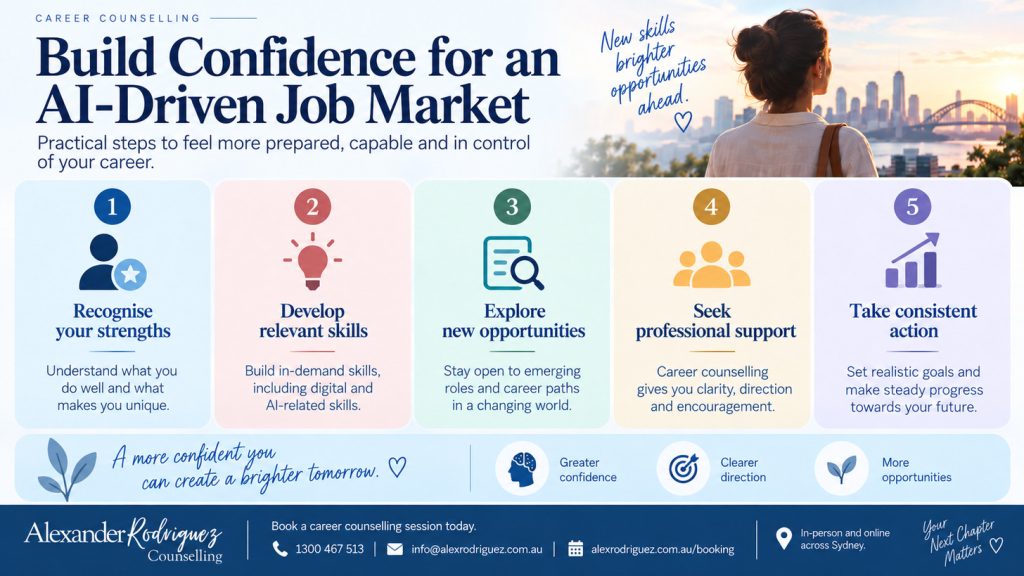
Feeling unsure about your career path is common, and it does not mean you are behind or falling short. Looking honestly at the evidence, your track record, your feedback, your problem-solving, can help you see your unique value more clearly than worry usually allows. As the future of work continues to evolve, your ability to remain steady often depends less on the pace of change itself and more on how you perceive and value your own contributions.
Replace Self-Doubt with Evidence of Your Capabilities
Rapid technological shifts can feel overwhelming. Instead of focusing on what you lack, record your tangible achievements and successful projects. A record of your wins proves your skills remain relevant.
Use Confidence and Self-Belief Building Strategies
Professional support can help when you feel stuck. Through Career Counselling, you can identify human strengths, such as complex judgement and emotional intelligence, that AI cannot replicate. These sessions help you change your inner story and focus on your resilience.
Prepare a Clear Personal Value Statement
A strong value statement acts as your professional anchor. It should show how your unique mix of experience and human insight solves problems for your employer. Explaining your worth in one or two sentences shows authority and clarity during change.
Practise Speaking About Learning, Change and Career Achievements
Communication is a vital tool for navigating the future of work. Practise describing how you adapted to new systems or led successful initiatives in recent years. Explaining your growth journey shows potential employers that you are proactive and capable.
Turn Feedback and Setbacks into Practical Development Goals
Every piece of feedback is an opportunity to refine your approach. Rather than viewing a setback as failure, use Career Counselling to set a specific development goal. This mindset turns challenges into a roadmap for ongoing professional success.
Refresh Your Resume, Interviews and Professional Story
Your professional story is a powerful tool in a changing job market, often more powerful than a simple list of past duties or responsibilities. Crafting your narrative well does more than describe what you have done; it shows employers your future potential and the direction you are heading in. By improving how you present your experience, whether in your resume, a cover letter, or an interview, you can show employers that you welcome change and bring genuine adaptability to the role.
Update Your Resume to Highlight Adaptability and Results
Modern employers want proof that you can manage changing priorities. Instead of listing only past tasks, use your resume to show measurable outcomes and quick learning. Use active verbs to show your proactive approach to career growth.
Show How You Work Alongside AI and Digital Systems
You do not need to be a software engineer to show technical skill. Clearly explain how you use AI skills for jobs to improve daily productivity and decisions. Show how you keep human oversight and critical judgement while using digital tools for better results.
Prepare Interview Examples Using the Situation, Action and Result Structure
When you enter an interview, use the STAR method to give clear evidence of your abilities. Describe a specific Situation, the Action you took to solve a problem, and the positive Result you achieved. This structure helps hiring managers see how you apply your skills in real-world situations.
Use Resume and Interview Preparation Support to Improve Your Presentation
Sometimes, an outside view can improve how you explain your value. Professional Career Counselling can help you choose experiences and frame career changes confidently. Expert guidance keeps your story consistent, professional, and relevant to modern recruiters.
Build a Portfolio of Skills, Projects and Measurable Achievements
A portfolio gives tangible proof of your expertise beyond a standard document. Gather evidence of your work, such as:
- Reports or projects where you successfully integrated new technology.
- Examples of complex problems you solved using critical thinking.
- Metrics showing how your work improved efficiency or team performance.
Documenting these wins creates a strong case for your future value. Engaging in Career Counselling helps you organise this portfolio, so each item supports your long-term goals.
Access Personalised Career Counselling with Alex Rodriguez Counselling
f you feel unsure about your work path, Alex Rodriguez Counselling offers personalised support to help you find clarity and move forward with confidence. The future of work can feel hard to navigate alone, especially when there is so much conflicting information about what it means for your industry or role. Our Counselling Service is designed to help you work through these concerns in a safe, supportive space, so you can build a clearer sense of direction and greater confidence in your professional life.
Choose In-Person Career Counselling in Blacktown
People in Western Sydney can meet us in a welcoming space for face-to-face consultations. Our convenient office offers a personal connection that can help during major life decisions. We serve the local community with expert career planning advice.
Use Online Career Counselling Sessions Across Australia
You can use our expertise without visiting Blacktown. Our online career counselling sessions bring support to your home anywhere in Australia. This flexible option provides guidance without the stress of travel.
Match Your Needs with Career Counselling Support
We understand that everyone faces different challenges when it comes to their career and professional life. Our career counselling services are tailored to your individual situation, offering practical, relevant support wherever you are in your journey.
Areas we can support you with include:
- Career reflection and direction
- Career coaching and career change support
- Return-to-work support
- Redundancy and job loss support
- Workplace stress and burnout support
- Imposter syndrome support
- Workplace anxiety support
- Confidence and self-belief building
- Values and strengths clarification
- Goal setting and career planning
- Resume and interview preparation support
Book a session with Alex Rodriguez to discuss which type of support may be the right fit for you.
Taking the first step towards a more secure future is simple. Contact us today to discuss how our counselling service can help you reach your goals. Whether you need help with career planning or navigating the future of work, we are here to help.
Address: Suite 207a, 30 Campbell St, Blacktown, NSW 2148, Australia
Phone: 1300 467 513
Email: info@alexrodriguez.com.au
Online booking: https://www.alexrodriguez.com.au/counsellor-booking/
Conclusion
Artificial intelligence is changing the way Australians work, but change does not have to mean uncertainty or fear. As you have seen throughout this article, job security in an AI-driven world depends less on avoiding change and more on how well you prepare for it. By focusing on your transferable strengths, building relevant AI skills for jobs, and following a clear, practical approach to career planning, you can move through this period of change with far more confidence than headlines about AI replacing jobs might suggest.
A genuinely future-proof career is not built overnight. It develops gradually, through small, steady steps, honest reflection, and support along the way. Whether you are feeling unsettled about where the future of work is heading, facing redundancy, returning to work after a break, or simply want a clearer sense of direction, you do not have to work through it alone.
You don’t have to navigate career uncertainty, workplace stress, or life’s challenges on your own. Alex Rodriguez offers personalised, professional support designed to help you feel more confident, more capable, and more in control of your next move, with flexible in-person and telehealth options available across Sydney and Parramatta. Call 1300 467 513, email info@alexrodriguez.com.au, or book an appointment online at a time that suits you.
FAQs
Will AI take over my job completely?
For most people, the answer is no. Evidence suggests AI is more likely to change parts of your role than eliminate it altogether. Reports such as the Tech Council of Australia’s 2024 analysis point to AI creating new roles alongside automating routine tasks, rather than replacing entire professions. Jobs built around empathy, judgement, creativity, and complex problem-solving tend to remain valuable, even as specific tasks shift towards digital tools.
What is career counselling and how does it help with AI job security?
Career counselling is a supportive, structured process where you work with a professional to reflect on your career, clarify your direction, and build a practical plan for change. When it comes to AI job security, career counselling can help you understand which parts of your role are genuinely at risk, identify transferable skills, and develop AI skills for jobs that keep you relevant, all while addressing any anxiety or uncertainty you may be feeling along the way.
How do I know if my job is at risk from automation?
A useful starting point is reviewing your daily tasks and asking which ones are highly repetitive or rules-based, since these are often the first to be automated. Roles that rely heavily on human connection, strategic thinking, or creative problem-solving tend to be more resilient. A career counsellor can help you assess this more thoroughly and tailor a career planning approach specific to your industry and role.
What AI skills should I focus on developing?
You do not need to master every new tool. Instead, focus on AI skills for jobs that directly support your current role and industry, such as basic AI literacy, data awareness, and critical thinking around how algorithms are used in your field. Pairing these technical skills with strong human abilities, like communication and adaptability, tends to offer the most reliable job security over time.
Is it normal to feel anxious about AI and my career?
Yes, this is a common and understandable response to rapid workplace change, and it is not a sign of weakness. Many Australians are feeling similar concerns as technology reshapes their industries. If these feelings start to affect your daily life or wellbeing, speaking with a Counselling Service can offer a safe space to process them and build a clearer, more manageable plan forward.
Do you offer career counselling in person or online?
Yes. Alex Rodriguez Counselling offers in-person career counselling at our Blacktown office, as well as online career counselling sessions for clients across Sydney, Parramatta, and the rest of Australia. This flexibility means you can access support in whichever way suits your circumstances and location.
Can career counselling help if I am facing redundancy or returning to work?
Yes. Career counselling can support you through redundancy, job loss, or returning to work after a break, helping you translate past experience into future-focused opportunities and rebuild your confidence at a manageable pace. Alex Rodriguez Counselling offers dedicated Redundancy and Job Loss Support and Return-to-Work Support as part of this service.
What if I am struggling to cope with workplace stress or anxiety?
If workplace stress, anxiety, or uncertainty about your career is affecting your wellbeing, it is worth reaching out for support rather than managing it alone. Career counselling can help address both the practical and emotional sides of career change. If you are in crisis or need urgent support, please contact Lifeline on 13 11 14 or emergency services on 000.